
The real estate market shifts each decade, making the experience of buying and selling a home unique for each generation. Yet, regardless of the challenges of buying a home, one sentiment is evident: it’s worth the stress. Why? A 2022 Zolo survey found that 87% of North Americans believe a home is a good investment no matter their age.
Currently, the four generations in the market to buy a home include:
- Generation Z (1997 – 2012)
- Millennials (1981 – 1996)
- Generation X (1965 – 1980)
- Baby Boomers (1946 – 1964)
Unsurprisingly, the desire to buy decreases with age, as 70% of Generation Z, 64% of millennials and 53% of Generation X plan to purchase in the next year. In contrast, 54% of boomers do not intend to buy a home in the next year.
Your Guide to Buying a Home:
- Best Strategies to Save a Down Payment
- How Much Home Can You Afford?
- Ultimate Guide to Mortgage Pre-Approval
- How to Find a Real Estate Agent
- What to Look For When House Hunting
- Your Complete Guide to Negotiating the Purchase Price
- How to Get Mortgage Approval
- Your Possession Day Checklist
How Do We Feel About the Real Estate Market in 2022?
With rising interest rates and record-high inflation levels, buying a home in the current market can feel unattainable. Our survey found that 42% of North Americans worry they’ll never be able to buy a home, with millennials being the most fearful of each generation when it comes to their ability to afford a home.
Statistics show that millennials are the largest workforce in North America, but are the least wealthy of all generations, so their anxiety about homebuying makes sense. At roughly the same age as millennials, boomers owned 21.3% of the national wealth. Millennials own just 4.6% and carry a more significant student loan burden than their parents.
Generation Z is the most confident they’ll be able to afford a home in 2022, with 61% of respondents optimistic they can purchase a home this year. And although millennials report the most anxiety, 52% of those planning to buy still feel confident, with 48% of both Generation X and boomers feeling the same.

Top Challenges of Buying a Home
Knowing how much worry exists surrounding housing affordability begs the question of which obstacles are preventing each generation from buying property. Respondents’ top three roadblocks to homeownership include saving a down payment, a competitive housing market, and not having enough income.
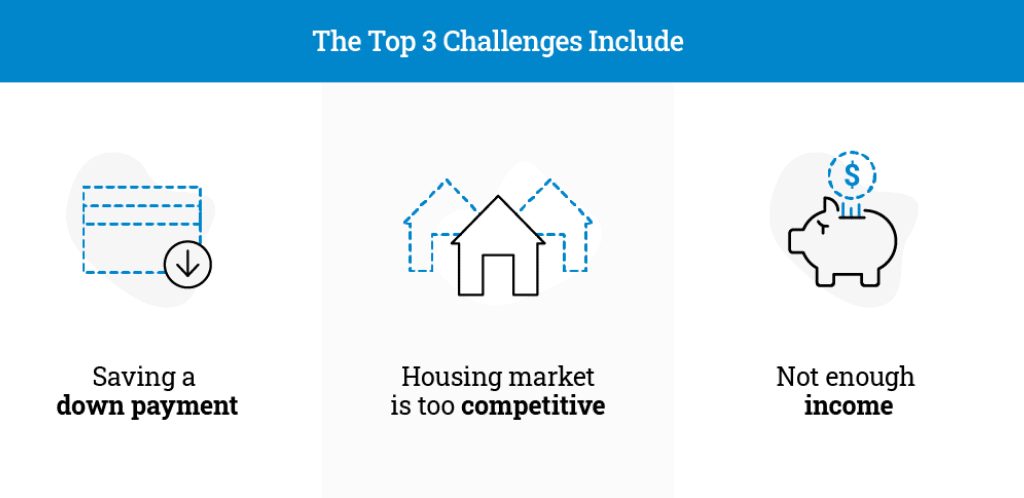
What are the Generational Differences and Challenges of Buying a Home?
For Generation Z, millennials and Generation X, the inability to save up a large enough down payment is the top challenge in buying a home. But for boomers, the competitive housing market is the biggest obstacle.
Suppose the competitive housing market and saving a significant down payment are growing concerns. In that case, Mustafa Abbasi, President of Zolo, has three recommendations for how best to manage the real estate market through 2022 and beyond.
- Make sure you do your financial homework first. Get pre-approved to know what you can afford, and if you find a home you like, you can act quickly. Many buyers see surprises during the search process because they didn’t get pre-approved. One less stressful task to deal with is if you get pre-approved upfront.
- If you’re a first-time buyer and can’t find your forever dream home, that’s okay. Look at more affordable options as a way to get into the market. Real estate wealth is built over time, be flexible and have a long-term plan to get into your dream home. Once you own, you start building equity almost immediately.
- Don’t panic or stress. Ignore the scary headlines about the state of the market. The reality is that you know one can predict the market. Do what makes sense for you, and always have a long-term plan. It helps to work with professionals that can help make the process easy and less stressful.
How Does Each Generation View Financial Support?
In February 2022, the Canadian Real Estate Association reported the average cost of a Canadian home had hit its highest price on record of $816,720. The United States also sees skyrocketing prices, with an average price increase of 11.8% year over year.
For that reason, it’s becoming increasingly common for homebuyers to receive financial support from loved ones. While some people may not love the concept of a gifted down payment or think it’s a good idea for first-time buyers, most generations are becoming increasingly more comfortable with the idea.
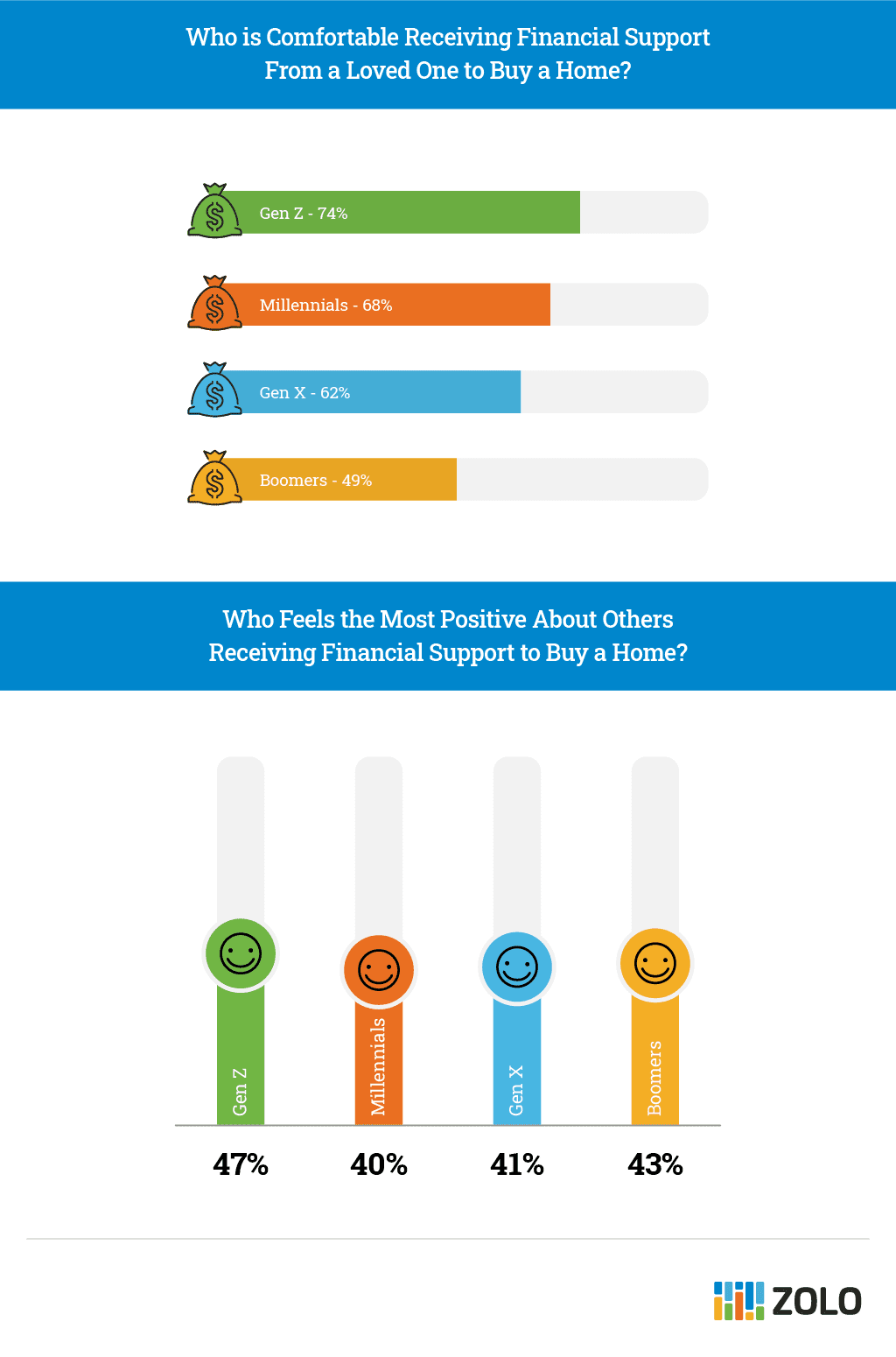
Regardless of age, having some financial gift from a family member or loved one is welcomed by 66% of North Americans. However, the generation most comfortable receiving financial support for themselves is Generation Z at 74%. They’re quickly followed by 68% of millennials, 62% of Generation X and 49% of boomers.
As far as how they feel about others receiving financial support, most respondents feel neutral, while 42% feel positive. In addition, only 9% of respondents feel pessimistic about seeing others receive a gifted down payment.
When it comes to who is most in support of others receiving financial assistance, Generation Z (47%) and boomers (43%) were the most positive about others receiving help from relatives or friends to buy a home.
Final Thoughts
Although the real estate market cannot be predicted, there is something to be said about our continued willingness to purchase property and invest in homes. Generation Z is the next generation to leap into the real estate market, and they are perhaps doing it at the most challenging time in history. Yet, they remain confident and poised to buy their first home.
Having shelter will always be a necessity. So, regardless of whether you plan to buy, you will always need a place to live.

Survey Details
The survey data used for the Zolo North American Buyers’ Sentiment Report was collected through an online survey in April 2022.
The online survey asked 3,076 respondents a variety of opinion, self-report and knowledge-based questions to measure their opinion on the current real estate market, their plans to purchase a home, and their feelings about buying property.
The estimated margin of error is +/- 2 percentage points.