Learning how to negotiate is a powerful tool for anyone, no matter their age or career level. From asking for a raise to schmoozing a car salesperson for a better deal, good negotiation skills can help you advance in many aspects of your life.
Those who aren’t well-versed in the art of negotiating might feel nervous when called to the table. In fact, negotiation is more about listening and finding common ground than it is about being confrontational. When people think about it as a well-balanced conversation over an argument, it can become less scary and more attainable. Before jumping into lessons around how to negotiate, let’s first address the many benefits of sharpening your skills.
The Benefits of Learning How to Negotiate
Knowing how to negotiate is valuable at any age. However, as you get older, negotiation skills become more important in carving out your life’s success. For example, when negotiating the price of a house, the stronger your negotiation skills are, the higher your chances of getting your preferred home at a better price.
There are also many benefits to being a good negotiator other than increasing your bottom line. It can help you build better relationships, find creative solutions and avoid future problems and conflicts.
Although negotiation is beneficial, these skills are rarely inherent, so they take practice. We’ve sourced lessons from some of the best negotiators in the world to help readers sharpen their negotiation skills and learn real-world tactics to put into practice.
Keep reading for tips from some of the most influential negotiation pros and business moguls.
9 Negotiation Lessons From Pros + Business Moguls
Influence rarely comes easily, but when harnessed, it can have a major payout. The tips below will equip you to negotiate like a pro and are applicable in various situations, from negotiating a job offer to negotiating a curfew with your kids.
1. Prepare Ahead of Time
Contrary to popular belief, negotiation isn’t about shooting from the hip and coming up with solutions on the spot. Preparation is critical to a successful negotiation. When you’re prepared, you’re able to state your case more clearly and, most importantly, know when to walk away.
In his article “How To Be A Good Negotiator,” Steve Gates, author of The Negotiation Book, writes that “90% of successful outcomes of any negotiation comes from planning.” Planning helps negotiators fully understand the situation, evaluate the priorities of everyone involved and better understand roadblocks.
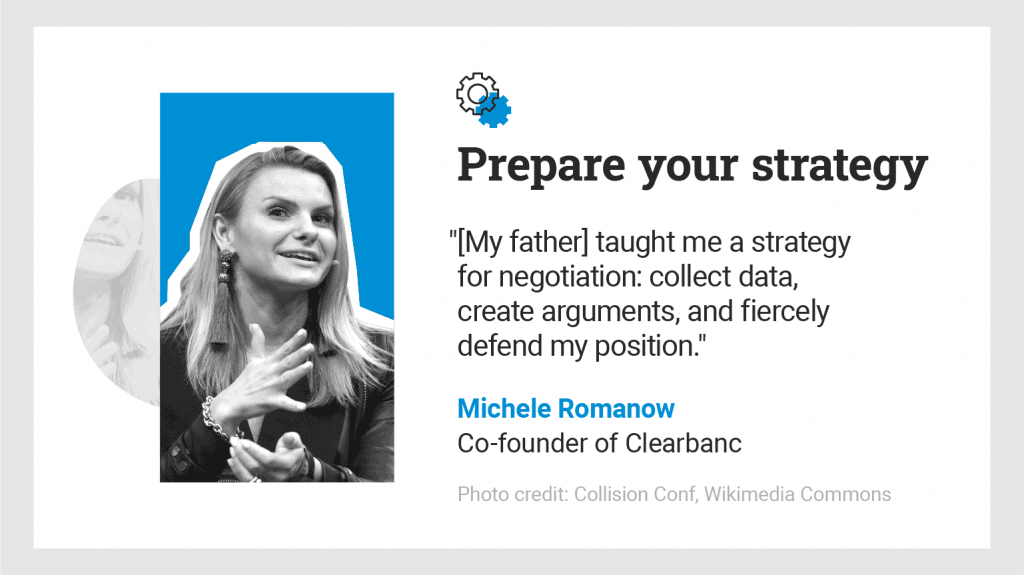
Once you’ve prepared a plan that’s complete with hypothetical scenarios and contingency plans, the next step is to gain confidence and strongly defend your position. Michele Romanow, tech entrepreneur and co-founder of Clearbanc, learned the importance of preparing your negotiation strategy at a young age when asking her father for a later bedtime. She writes in a Flare article, “Before my parents would agree to it, they had me do a survey to get the average bedtime of my classmates.” Much to her dismay, all of her classmates had earlier bedtimes than she, but despite this evidence, she still argued to go to bed later. She writes that “He taught me a strategy for negotiation: collect data, create arguments, and fiercely defend my position.”
2. Know When to Walk Away
Determine when you’ll walk away before you even approach the negotiation table, as it provides you with the confidence you’ll need to successfully negotiate.
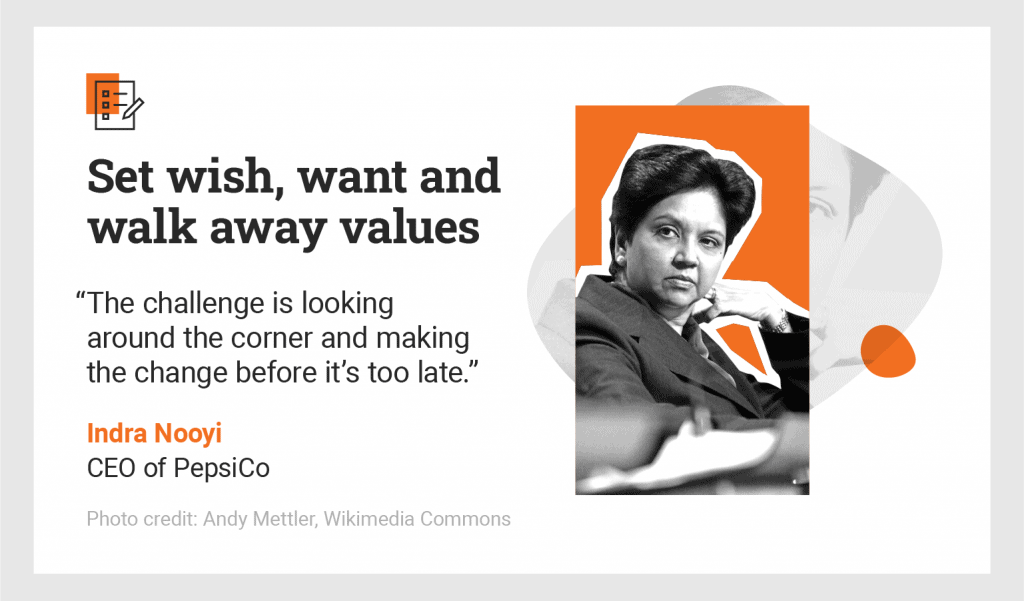
Indra Nooyi, CEO of PepsiCo, said in an interview with Walmart President and CEO Doug McMillon, “The challenge is looking around the corner and making the change before it’s too late.” Set wish, want and walk away values in advance so that you’ll know if and when it’s time to accept or pursue another alternative.
3. Align Your Goals With a Higher Purpose

Ambition is valuable in a negotiation setting, and Elon Musk is a great example of that. Musk, the CEO of Tesla and serial entrepreneur, has been remarkably successful negotiating and securing billions from investors. Why? He follows the “north star” model by finding a higher purpose to align his goals with.
Musk famously said, “The first step is to establish that something is possible; then probability will occur.” When you find the higher purpose in your proposal and share your goals as a way of achieving that purpose, you will see more partners aligning with your goals.
4. Reason With Empathy

Negotiation is a two-way street, a give and take scenario. The most successful negotiations are conversations, not arguments. The key to a successful conversation is developing and demonstrating empathy — the ability to understand another person’s feelings, motivations and intentions.
In an interview with Dan Schawbel, Marc Randolph, CEO of Netflix, discusses his views on negotiation. When you ask for something during a negotiation, what Randolph calls the “naked ask,” he advises that the best way to do it is to be honest and vulnerable. He says, “revealing what you want in your voice, words and body lets people know that this is not “B.S.,” but that you believe in what you are asking for.”
5. Ask Open-Ended Questions

Good negotiators are very patient, ask a lot of questions and are very concerned about understanding exactly what the other party is trying to achieve. Chris Voss, the FBI’s lead international kidnapping negotiator, explains in his book, Never Split the Difference, that you want to start every negotiation the same way: “With a good opening question.” Asking calibrated, open-ended questions, he says, “allows you to introduce ideas and requests without sounding overbearing or pushy.”
Open-ended questions often begin with the words who, whose, what, when, which, why or how. This type of probing can help you uncover underlying fears and motives. Bill Gates, Founder of Microsoft, emphasizes the importance of paying attention to the other person’s feelings to best address their concerns. He famously said, “If you show people the problems and you show the solutions, they will be moved to act.”
6. Emphasize the Value of Your Request
If you are negotiating over the price of something, always justify your offer, but never apologize for it. Economist Deepak Malhotra wrote in an article for Harvard Business Review, “When you apologize, you signal that even you don’t think the price is appropriate, and you give the other side license to haggle. The entire frame of the negotiation becomes about price, when what you really want to discuss is value.”
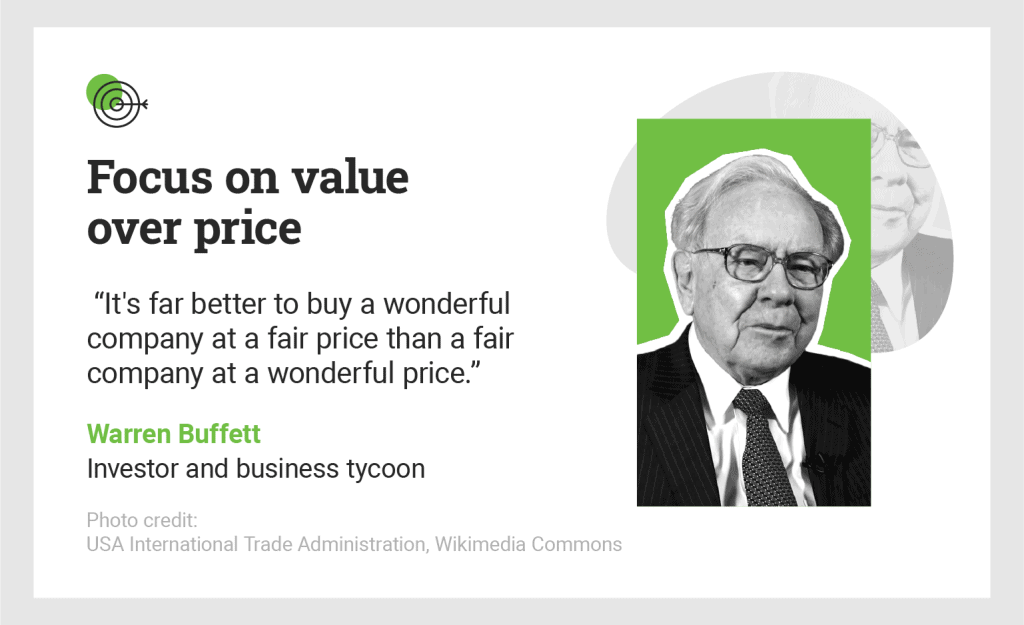
Focusing on the value of your offer will help you resist the urge to fall into a quick deal or let bumps in the road deter your plan. As Warren Buffett, investor and business tycoon, once said in a letter to his shareholders, “It’s far better to buy a wonderful company at a fair price than a fair company at a wonderful price.”
7. Find Your “Zone of Fairness”
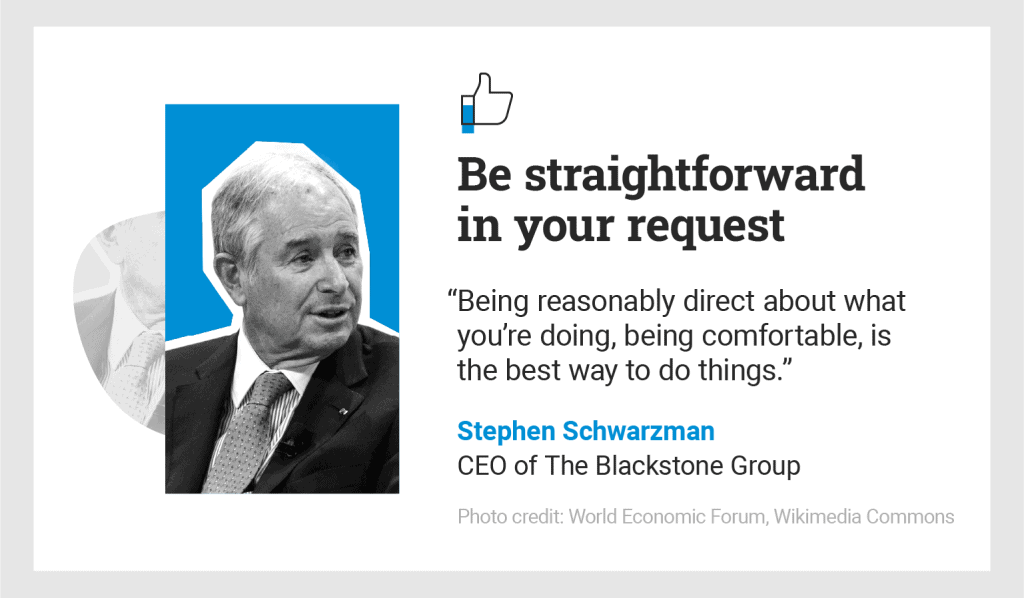
When negotiating, making a deal has to do with discovering the overlap of what both sides want. During an interview with CNBC, Stephen Schwarzman, CEO of The Blackstone Group, called this area the “zone of fairness.” He says, “Transacting at a level that is more beneficial to your side than what exists within that zone is seldom possible, because someone on the other side almost always ultimately wakes up.” He says, “Being reasonably direct about what you’re doing, being comfortable, is the best way to do things.”
8. Learn From Every Negotiation

Every negotiation is an opportunity to learn and grow. Maybe you accidentally revealed your bottom line or got the numbers mixed up — the important thing is taking every lesson as an opportunity to learn and move forward. Sean Kelly, CEO and co-founder of SnackNation, writes in an article for Entrepreneur that, “Just getting a deal done isn’t always enough.” He encourages people to always ask for more and says to ask themselves: “What else could have been done? Could something have been tied to the back-end?”
Ginni Rometty, CEO of IBM, advocates for negotiators to get out of their comfort zone, as it is the only way to grow. She said at Fortune‘s Most Powerful Women Summit, “Growth and comfort do not coexist,” so the only way to learn from mistakes amid negotiation is to make them.
9. Negotiate Bravely
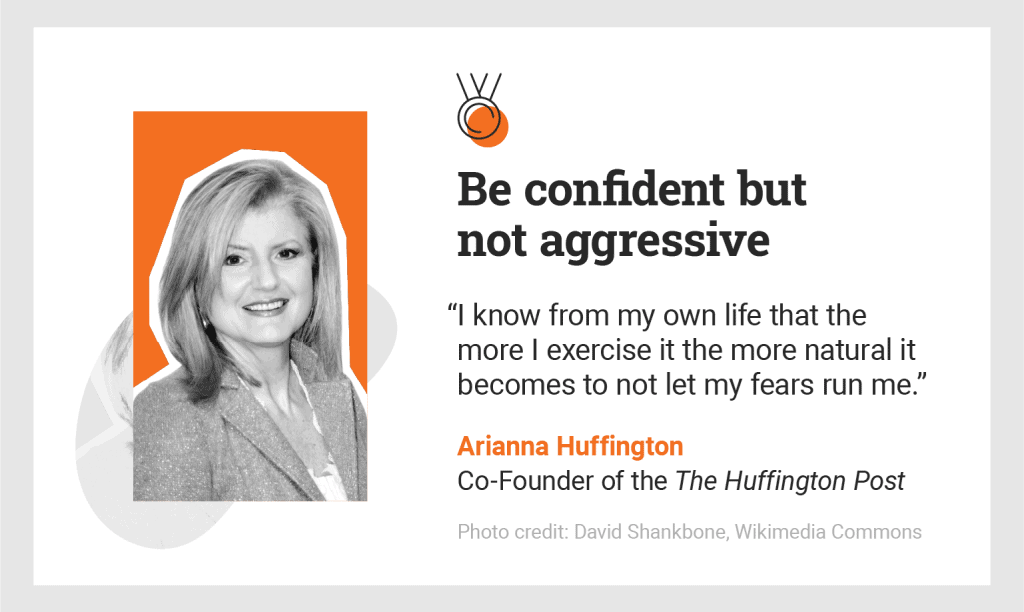
Lastly, be confident and fearless when approaching a negotiation table. While that might be easier said than done, having confidence can actually heighten your chances of achieving a successful outcome. Tony Hughes, CEO of Huthwaite International, advises being confident but not aggressive. He says, “Try to strike the right balance with your negotiation partner and focus on long-term partnerships.”
Not everyone is inherently confident, and some successful people believe that fearlessness is like a muscle. Arianna Huffington, co-founder of The Huffington Post, famously says, “I know from my own life that the more I exercise it the more natural it becomes to not let my fears run me.”
How to Put These Lessons Into Action
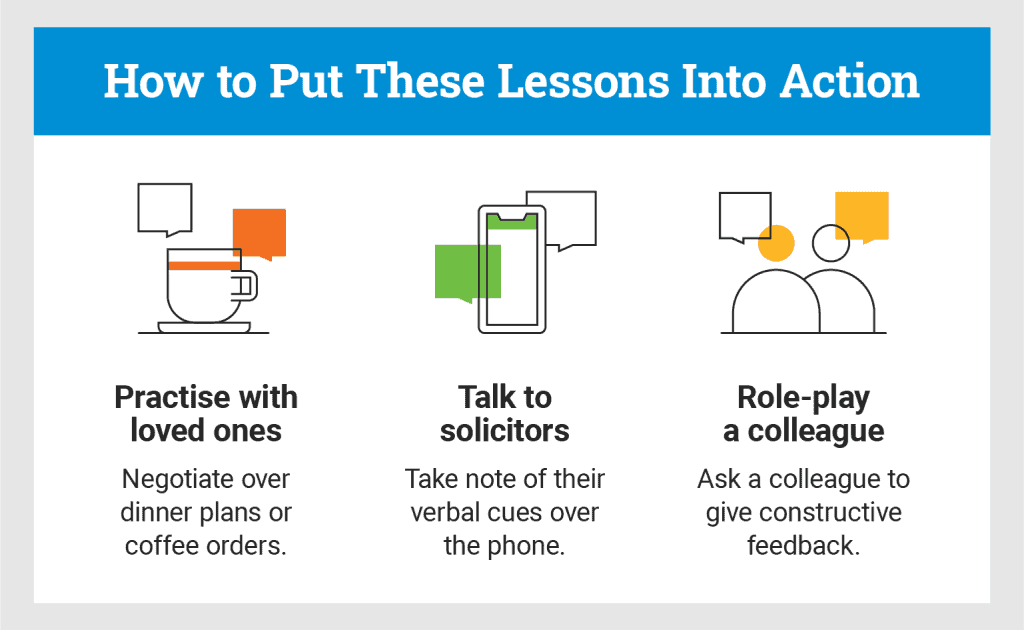
Without practice, entering a negotiation can feel more like entering a boxing ring. When you practice your skills in everyday interactions, you can begin to see negotiation as a process towards an agreement, rather than an argument, making you feel more comfortable during high-stakes situations.
There are opportunities all around us where we can improve our negotiation skills. To help you put these lessons into action, check out the following ways to flex your negotiation muscle.
Practise With Friends and Family
Treating everyday interactions like negotiations can help you put your skills to work in a low-pressure environment. Invite a friend or family member to go out to dinner, and treat the restaurant as the deciding factor. Prepare your reasons for selecting one restaurant over another and listen to their counter with empathy and logic. Get to the bottom of their needs by asking them open-ended questions to understand the other person’s point of view.
Talk to Solicitors
Rather than letting those solicitor calls go straight to voicemail, consider taking the time to speak with them as an opportunity to practice your negotiation skills. Not all negotiations are in-person (especially these days), so learning how to read verbal cues can give you a leg up.
Role-Play or Shadow a Colleague
Practicing negotiation doesn’t always have to happen in real-life scenarios or right before a big meeting. Sometimes a healthy role-play with a colleague can provide a low-stress opportunity to practice what you’ve learned on someone you trust. Be open to receiving feedback and treat the exercise seriously.
Negotiation Resources
Don’t let your negotiation lessons end here. Explore our resources on negotiation to keep improving your skills.
- Harvard Law’s List of Best Negotiation Books
- Inc. Magazine’s List of 7 Best Negotiation Books
- Free Negotiation Resources from the Negotiation Experts
- The Black Swan Group Resource Library
Anyone can learn how to negotiate, but the most successful negotiators commit to practicing and using their skills often. For more information on how you can get the negotiation process started on a new home, explore our available houses for sale in Toronto or Calgary to get the inspiration flowing.