

While many Canadians expect to get a mortgage through a traditional bank, not everyone gets approved. But B lenders, also known as subprime lenders, offer an alternative solution for those with lower credit scores, irregular income, or high debt levels. In the last quarter of 2024, 30.4% of new mortgages were through a credit union, mortgage investment entity, or other non-bank mortgage lender, according to the Canada Mortgage and Housing Corporation, a decrease from 35% in the last quarter of 2023.
This guide will help you understand what B lenders are, how they differ from A lenders, and the advantages and drawbacks of choosing them.
Key Takeaways
- B lenders in Canada offer mortgages to people who might not qualify for a regular bank loan (A lenders). This is often because they have lower credit scores or less traditional jobs
- B lenders usually have higher interest rates and fees, and shorter loan periods
- A mortgage broker can guide you through the B lender options to find the best mortgage for your unique financial situation
What Exactly are B Lenders in Canada?
B lenders are financial institutions that provide mortgages to people who traditional A lenders, such as big banks, may not approve. Unlike A lenders, who have strict lending rules, B lenders:
- Help homebuyers who have unique financial situations, such as lower credit scores, irregular or self-employed income, or high debt levels
- Are more flexible with their mortgage terms
- Don’t have to follow the mortgage stress tests that A lenders must adhere to
Sometimes called subprime or alternative mortgage lenders, B lenders in Canada include trust companies, credit unions, and private lenders.
Key Differences Between A Lenders and B Lenders
The key differences between A and B lenders are the rules they use to approve loans and the interest rates they charge.
A lenders usually require a minimum down payment of 5% and a credit score higher than 680. B lenders, on the other hand, might accept credit scores as low as 500 and typically ask for a down payment of at least 20%. Also, A lenders require you to pass a mortgage stress test, but B lenders are less strict about how much debt you have compared to your income, often allowing higher ratios than A lenders.
Interest rates also differ significantly between the two. B lender mortgage interest rates are typically 1.25% to 2% higher than A lenders.
Additionally, B lenders generally offer shorter mortgage terms, typically ranging from three months to three years, whereas A lenders typically offer longer options.
Types of B Lenders in Canada
B lenders in Canada include a variety of financial institutions, including lenders that only focus on mortgages (monoline lenders), mortgage finance companies, private lenders, and credit unions.
Understanding the different types of B lenders can help you find a mortgage lender that best suits your financial situation.
Monoline Lenders
Monoline lenders are financial companies that only offer mortgage products. Typically, you need to work with a mortgage broker to get a mortgage through a monoline lender. Lender mortgage rates from monoline lenders can be competitive and often vary depending on your credit profile and financial situation.
Some examples of monoline lenders in Canada are First National, Merix, MCAP, Nesto, and Pine.
Mortgage Investment Corporations (MICs)
Mortgage investment corporations are entities that pool money from multiple investors to offer mortgages to people who may not qualify for a traditional mortgage. Typically, MICs require a minimum down payment, sometimes as high as 35%, and the mortgage term is short, often lasting one or two years.
Some of the MICs in Canada are Alta West Capital, MCAN Financial Group, Connect, Timbercreek Financial, and Amur Capital Income Funds.
Private Lenders
Some lenders offer private mortgages in Canada. These lenders could be an individual, corporation, or syndicate. A mortgage investment corporation is one type of private lender.
Since private lenders are not bound by the same rules as banks, they set their own interest rates and rules for who qualifies. If you get a mortgage through a private lender, you will likely pay higher interest rates compared to an A lender.
Examples of private lenders in Canada include Bridgewater Bank, Clover Mortgage, and Vault Mortgage.
Credit Unions
Credit unions are member-owned financial institutions that focus on serving their local communities. They often offer more flexible mortgage options, and many credit unions do not impose the same strict stress tests as big banks..
Credit unions typically provide both residential mortgages and commercial mortgages to their members, offering a range of financing solutions for homebuyers and business owners alike.
Why Choose a B Lender? The Advantages
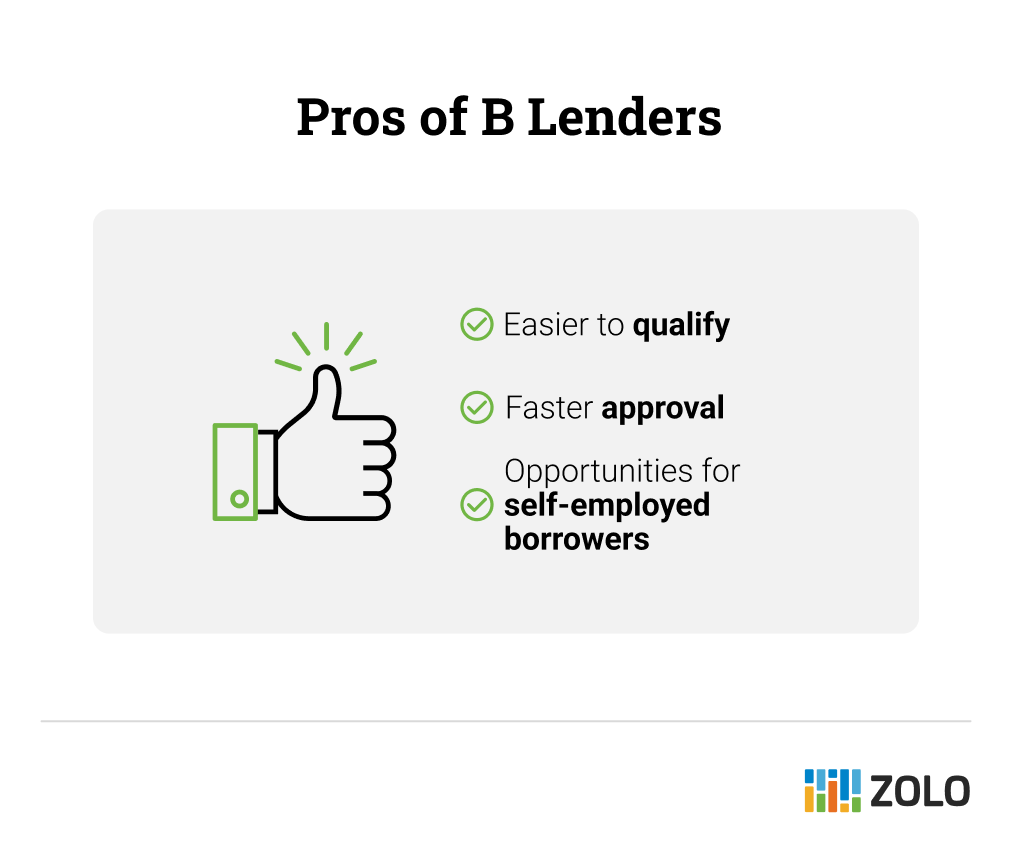
Most homebuyers get a mortgage from a B lender because they don’t qualify for an A lender mortgage. Advantages of using a B lender include:
- Easier to qualify – Typically, B lenders look at your whole financial picture, not just credit scores, debt ratios, and your credit history
- Opportunities for self-employed borrowers – It can be difficult for self-employed people to prove their income to traditional lenders, but B lenders recognize and accept various sources of income
- Faster approval – Getting a mortgage from a B lender in Canada is generally quicker than an A lender, allowing you to get access to funds quickly
The Drawbacks of B Lenders: What You Need to Know
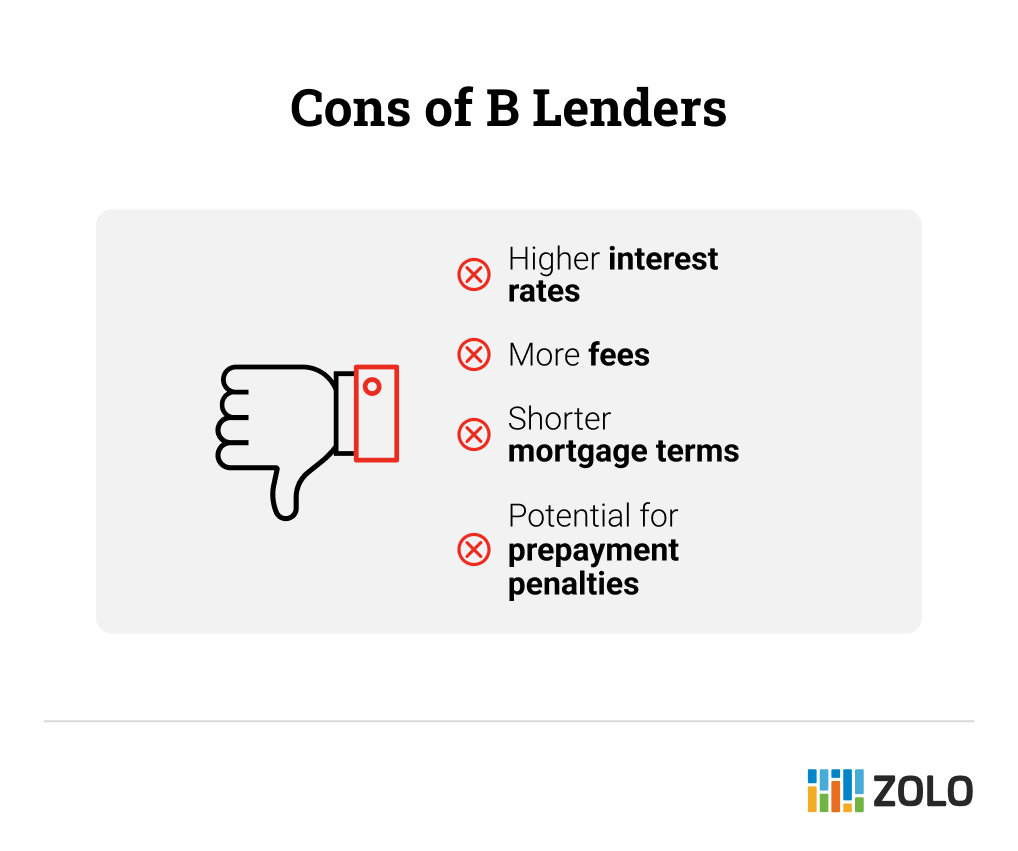
While B lenders can be helpful, there are some downsides to consider. Here are some of the challenges of working with a B lender:
- Higher interest rates – B lender interest rates may be 1.25% to 2% higher than those of an A lender. Higher interest rates mean higher monthly mortgage payments
- More fees – B lenders often charge extra fees, like broker fees or lender fees, that drive up the total borrowing cost
- Shorter mortgage terms – B lender mortgage terms typically range between one and three years. This shorter duration encourages borrowers to move to an A lender, but it also means renewing the mortgage more often
- The potential for prepayment penalties – While B lenders may offer good prepayment options, they may charge a large fee to pay off your mortgage early
Alternatives to Using a B Lender in Canada
Qualifying for a traditional mortgage with an A lender can help you avoid higher interest rates and fees. Ways you can improve your mortgage application include:
- Securing stable income – A lenders like to see stable and consistent income to ensure that you will pay your mortgage
- Improving your credit score – Increase your credit score by paying off debt, making payments on time, and using less than 30% of the credit you have available
- Increasing your down payment – A larger down payment can greatly improve the chances of being approved by an A lender
- Utilizing government programs – Take advantage of first-time homebuyer incentives, such as down payment assistance programs, to help you buy your first home
- Using a co-signer with good credit – A co-signer or guarantor can strengthen your mortgage application and help you get approved by A lenders
Working with a Mortgage Broker: Your Best Bet
Working with a mortgage broker is a smart idea when applying for a mortgage. Brokers have access to a wide range of lenders and can negotiate better rates on your behalf.
Mortgage brokers guide you through the entire mortgage application process, explaining the steps and requirements for different types of lenders. Additionally, brokers can help you prepare the necessary documents, such as bank statements, to ensure your application is complete. They can also help you understand your options and find the best mortgage solution for your needs.
Bottom Line
B lender mortgages are a good option for people who do not qualify for traditional mortgage loans. These lenders provide more flexible qualification criteria, cater to self-employed individuals, and offer faster approval times. However, it’s essential to be aware that B lenders usually have higher interest rates, more fees, and shorter mortgage lengths.
Find your next home on Zolo.ca and get tips on buying, selling, and owning a home on the Zolo Blog.
B Lender FAQs
Do B lenders require 20% down?
B lenders usually require a down payment of 20% to 35% because their mortgages often don’t qualify for mortgage default insurance. However, some lenders and credit unions might accept a down payment as low as 5%.
Are B lenders safe?
Generally, B lenders are considered to be safe options for a mortgage in Canada. But, before you sign your mortgage paperwork, be sure to research the lender and review the terms and conditions of the mortgage.
What is the difference between an A Lender and a B Lender in Canada?
A lenders and B lenders differ mainly in who they lend to, how much interest they charge, and how much down payment they require. A lenders have tougher lending rules, but they usually offer lower interest rates and let you put less money down. B lenders have more lenient lending rules, but their interest rates are often higher than those of A lenders, and they may require a larger down payment.
How can I improve my chances of transitioning from a B lender to an A lender?
To switch from a B lender to an A lender, you need to meet their lending criteria by improving your credit score, paying off debt and proving that you have steady income. Getting help from a mortgage broker can also increase your chances of switching to an A lender.
