

No matter where you live, Canada’s housing market is likely a hot topic, and most conversations revolve around price. Are prices going up? By how much? Is now a good time to buy? Where is the best place to buy? When purchasing a home, house prices are the primary determining factor for many Canadians. After all, the average home price in Canada was $676,154 in September 2025, which is no small sum, even for high-earning families.
That said, there’s more to finding the right place to live than price. An affordable mortgage payment is great, but if you dislike the city you call home, have a long commute, or can’t find a job at all, is it worth it? In reality, many factors go into finding a community where you’ll thrive not just financially but also mentally, physically, and professionally. Keep reading to find our picks for the best places in Canada. These regions combine housing affordability with factors that contribute to a good quality of life.
Key Takeaways
- The top-rated city in Canada is Guelph, Ontario, according to our rankings
- Many of the most livable cities in Canada are large cities, thanks to good employment opportunities and household income
- Cities with low average home prices and higher than average household income make up the top 10 best places to live in Canada
Best Cities to Live in Canada
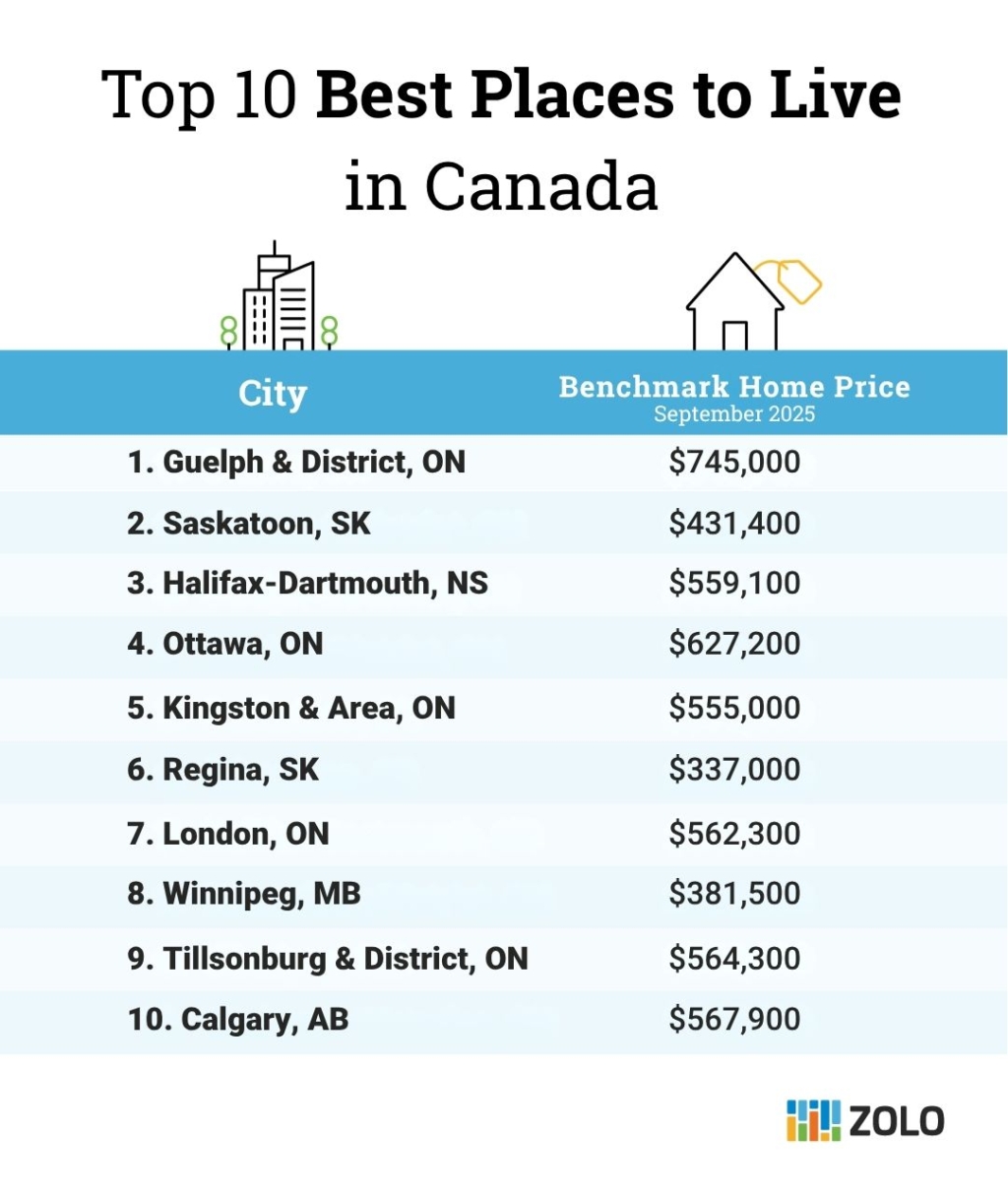
There’s much to consider when determining the best places to live in Canada. Home prices and household incomes are essential factors, but there are more nuances to consider. Many Canadians want to live in a safe community with high-quality jobs, green spaces, and access to healthcare providers.
To determine the most livable cities in Canada, we ranked regions according to the following factors:
- Home price
- Household income
- Population growth
- Unemployment rate
- Crime rate
- Access to a primary healthcare provider
- Sunny days per year
- Walkability
Guelph, Ontario
- Cost of Living: 3% lower than the national average
- Average Household Income: $119,100 per year
- Biggest Industry: Manufacturing, education, agriculture and food innovation, and environmental management technology
- Benchmark Average Home Price: $745,000
All things considered, Guelph is an excellent place to live in Canada. Guelph boasts higher-than-average household income, low unemployment rates, and is considered one of the safest cities in Ontario – all great reasons to move to Guelph.
Guelph residents love the small-town feel while having access to big-city amenities. Green space and walkability are important factors when choosing a place to live. Fortunately, Guelph boasts over 1,000 hectares of parks and more than 70 kilometres of paths and trails. Plus, the city offers a thriving arts scene, featuring a diverse range of entertainment options, festivals, and museums.
Saskatoon, Saskatchewan
- Cost of Living: 10% lower than the national average
- Average Salary (Household Income): $103,900 per year
- Biggest Industry: Agriculture, mining, healthcare, and education
- Benchmark Average Home Price: $431,400
Saskatoon was dubbed the third most livable city for young professionals in Canada, thanks to its affordable housing and the young population. Notably, Saskatoon enjoys one of the lowest costs of living among major cities in Canada, so your income stretches further, which is especially important for young Canadians.
While Saskatoon winters can be quite cold, the city is one of the sunniest in Canada, boasting approximately 320 days of sunshine per year – that’s nearly 89% of the year! Additionally, Saskatoon boasts entertainment venues, a diverse food scene, and numerous outdoor trails.
Ottawa, Ontario
- Cost of Living: 8% lower than the national average
- Average Household Income: $126,700 per year
- Biggest Industry: Public administration, technology, healthcare, and education
- Benchmark Average Home Price: $627,200
Canada’s capital city is a great place to live, thanks to a low crime severity index and good household income. Ottawa residents enjoy access to green spaces, museums, and educational opportunities. As a prominent tech hub, the stable economy only adds to the city’s desirability for families and young professionals.
Another great perk of living in Ottawa is the city’s proximity to other major cities in Canada. You can travel to Toronto or Montreal by train or car. Plus, the Ottawa International Airport easily connects you with many international and domestic destinations.
Halifax, Nova Scotia
- Cost of Living: 9% lower than the national average
- Average Household Income: $98,900 per year
- Biggest Industry: Information technology and gaming, wholesale and retail, and healthcare
- Benchmark Average Home Price: $559,100
As the capital city of Nova Scotia and the largest city in Atlantic Canada, Halifax has a lot to offer. Haligonians love living near the ocean and nature. You’ll often find residents strolling the boardwalk and through one of the many parks. Moreover, the downtown core is walkable and the city is full of restaurants, museums, and tourist attractions.
Although the benchmark home price has increased by 16.1% over the past three years (as of September 2025), homes in Halifax remain relatively affordable. Additionally, Halifax’s economy is robust, with unemployment rates at a low 5.8%. All of these factors make Halifax a great place to set down roots.
Kingston, Ontario
- Cost of Living: 12% lower than the national average
- Average Household Income: $103,000 per year
- Biggest Industry: Education, healthcare, and manufacturing
- Benchmark Average Home Price: $555,000
Kingston seamlessly blends the benefits of living in a close-knit community with the advantages of urban living. The region boasts a vibrant arts scene, featuring 24 museums, art galleries, and historic sites to enjoy.
The city has numerous post-secondary education opportunities, including Queens University, which ranks among the top 200 universities in the world, according to the QS World University Rankings. Additionally, Kingston is roughly halfway between Toronto and Montreal, which is great for weekend getaways to the big city.
Regina, Saskatchewan
- Cost of Living: 11% lower than the national average
- Average Household Income: $106,000 per year
- Biggest Industry: Agriculture, oil and gas production, and advanced manufacturing
- Benchmark Average Home Price: $337,000
Although there are numerous reasons to move to Regina, affordability is likely at the top of the list. Regina’s house prices are over 50% cheaper than the national average. Additionally, Saskatchewan boasts the fifth-lowest income tax rate and the second-lowest sales tax rate (11%) in Canada. The combination of these factors means that your income stretches further in Regina.
But it’s not just affordability that makes Regina great. The city boasts a strong job market with one of the lowest unemployment rates in the country. Moreover, Regina is an excellent place to raise a family, thanks to its quiet and safe neighbourhoods, which are close to elementary schools, parks, and community centres.
Winnipeg, Manitoba
- Cost of Living: 22% lower than the national average
- Average Household Income: $99,600 per year
- Biggest Industry: Advanced manufacturing, aerospace, and agriculture
- Benchmark Average Home Price: $381,500
Winnipeg is another affordable place to live in Canada. Housing prices are one of the lowest among major Canadian cities. Moreover, the city is one of the most culturally diverse cities in Canada, with over 100 languages spoken by Winnipeg residents.
While the cold and snowy winters have earned the city its nickname “Winterpeg,” the city is actually one of the sunniest in Canada. Residents embrace the weather and spend plenty of time outdoors exploring one of the many parks, trails, or lakes.
London, Ontario
- Cost of Living: 7% lower than the national average
- Average Household Income: $98,500 per year
- Biggest Industry: Healthcare, advanced manufacturing, and technology
- Benchmark Average Home Price: $562,300
The London census region (which includes St. Thomas, Strathroy, and portions of Elgin and Middlesex counties) is one of the fastest growing in Ontario, partially led by immigration and outflow from the Greater Toronto Area. This growth, combined with a low benchmark home price and low crime rates, makes London a great place to call home.
Londoners have excellent access to green space, earning it the nickname “Forest City”. Additionally, London boasts well-rated schools and hospitals, which are important factors for families to consider when choosing a place to live.
Tillsonburg, Ontario
- Cost of Living: 10% lower than the national average
- Average Household Income: $87,600 per year
- Biggest Industry: Manufacturing, food processing, and healthcare
- Benchmark Average Home Price: $564,300
As the smallest town on our list, you might be surprised to learn that Tillsonburg has grown significantly over the past decade. The population increased 17.3% from 2016 to 2021, and is projected to grow by 24.6% from 2026 to 2035.
Tillsonburg boasts a low unemployment rate of 6% and a low crime severity index of 56.4. These factors, combined with a lower-than-average benchmark home price, showcase Tillsonburg as a desirable place to live in Canada.
Calgary, Alberta
- Cost of Living: 7% lower than the national average
- Average Household Income: $129,200 per year
- Biggest Industry: Aerospace, energy, and technology
- Benchmark Average Home Price: $567,900
Last on our list of Best Places to Live in Canada, but certainly not least, Calgary is an excellent place to call home. Many Canadians have been moving to western Canada over the last several years in search of lower home prices and job opportunities. Additionally, Calgary boasts some of the highest after-tax incomes in the country.
Calgary is great for families, offering plenty of recreation facilities. Moreover, parents won’t be far from expert healthcare facilities as the Alberta Children’s Hospital ranked 12th on Newsweek’s list of the World’s Best Pediatric Hospitals in 2025.
How to Choose a City in Canada that’s Right for You
Before you choose where to live in Canada, you’ll need to decide what factors are important to you. For instance, young adults may want to consider rent prices, unemployment rates, and walkability, while families may consider schools, home prices, and access to a primary care provider to be their top priorities. Here are some common considerations:
Housing Prices
Housing prices are one of the most important indicators of the best places to live in Canada because a city could be an absolute utopia, but if you can’t afford to live there, you won’t be able to call that place home (we’re looking at you, Vancouver). Consider your housing budget compared to the average property prices before choosing the right city to call home.
Population Growth
When a city grows, it’s usually a good indicator that Canadians find it a desirable place to live. Growing cities can support a larger residential population and usually have good employment opportunities.
Population Density
Living in an urban centre close to employment, healthcare centres, and universities can be a real benefit for some Canadians. However, city life is not for everyone, and those seeking more space may prefer a small town with lower population density.
Unemployment Rates
Some cities have very low home prices, but if the economy is struggling, it may not be sensible to move there. Therefore, it’s essential to consider the key industries and unemployment rates before you choose to set down roots.
Crime Rates
Among the most important factors when choosing a place to live is whether you’ll feel safe in your community. Consider the crime rate for the city as a whole, as well as the neighbourhood you plan to live in.
Walkability
It’s well documented that walkable neighbourhoods are associated with better health outcomes and a general increase in happiness. These results are also borne out by home prices. Homes in urban, walkable areas tend to be more expensive, reflecting their high demand and popularity.
Access to a Primary Care Provider
More than 6 million people lack access to a family doctor in Canada. This may not be a problem for everyone – for example, a healthy 20-something may not value access to a family doctor. Other Canadians, such as those over 65 or those with young families, may find this lack of access problematic.
Number of Sunny Days
Sunshine increases the release of serotonin in the human brain. This chemical release is associated with better mood and helps people feel calm and focused. For these reasons, it’s no surprise that regions with more sunny days are considered desirable for many Canadians.
How to Buy a Home in Canada
After you’ve chosen the best place to live in Canada according to your criteria, you may want to buy a home. The first step should be to determine how much you can afford to spend on a home. Getting pre-approved for a mortgage is a great way to narrow down your budget.
Next, talk to a local real estate agent who specializes in the area where you wish to buy a home. They will assist you in finding a property that meets your needs and help you make an offer. Once you’ve made an offer on a home and it’s been accepted by the seller, you will work with a real estate lawyer and a mortgage provider to secure financing approval and remove conditions laid out in the purchase agreement. Finally, on closing day, your lawyer will close the sale and hand you the keys to your new home.
Bottom Line
While everyone has their own preferences when it comes to choosing a place to live in Canada, most of us can agree that we want an affordable and safe city with good job opportunities. A local real estate agent can help you find the right neighbourhood in the city you choose. Search Zolo.ca for homes for sale in the best places to live in Canada.
How We Calculated the Best Places to Live in Canada (Methodology)
In this data report, we chose 37 cities and regions in Canada and used data from various sources, including Statistics Canada and the Canadian Real Estate Association (CREA).
- Home prices – We gathered the benchmark home prices for all types of residential properties in September 2025 and ranked each city and region. We ranked areas with lower home prices better in our calculations
- Population growth – We compared the population of each city and region in 2016 and 2021 and ranked them according to their growth in that time span
- Household income – We used the average household incomes for each area from Statistics Canada in our calculations
- Unemployment rate – We examined the unemployment rates for the cities and regions on this list and ranked them accordingly. Lower unemployment indicates better economic opportunities and a higher corresponding ranking
- Crime rate – We used the 2024 crime severity index to determine the safety of each city or region
- Walkability – We gathered the Walk Score for each city and region. A higher walk score is more desirable
- Access to primary care provider – We gathered provincial data from Statistics Canada and used it to rank each city or region
- Number of sunny days – We looked at the number of sunny days per year in each city or region according to WeatherStats.ca and used this data when calculating the best places to live
We then assigned a ranking to each city, ranging from 1 to 37, in each data category. These rankings were then applied to a weighted calculation system, resulting in an overall score for each city or region. The highest-scoring cities rank at the top of the list, and the lowest-scoring cities rank at the bottom.
Best Places to Live in Canada FAQ
Which Canadian city has the highest quality of life?
Vancouver, British Columbia, boasts the highest quality of life index score of any city in North America, according to the Mercer 2024 Quality of Living Survey. Access to nature and recreation opportunities, combined with Canada’s political and economic stability, are just a few of the factors that influenced Vancouver’s high rating.
What is the safest city in Canada to live in?
According to the crime severity index, the safest cities in Canada are located in the Halton, Durham, and York regions of Ontario, as well as Quebec City and Ottawa. These cities boast an overall low crime severity index, with both violent and non-violent crime rates lower than the national average.
What factors determine the best places to live in Canada?
The factors we used to determine the best places to live in Canada include housing prices, average household income, unemployment rates, population growth, crime rates, access to a primary care provider, number of sunny days per year, and walkability.
What city in Canada has the lowest cost of living?
Sault Ste. Marie had the lowest cost of living of the cities we compared. According to Numbeo, the estimated monthly living costs for a family of four in Sault Ste. Marie is $4,610.00 per month (excluding rent), which is lower than the national average of $5,208.80.
