
Many of us spend a lot of time on real estate listing sites. We spend hours hunting for our favourite kitchens, the perfect backyard, and the ideal ensuite. So much so that 47% of Canadians spend between one to two years browsing real estate listings before they even start house hunting. Home buyers know what they want — and we want to help you further explore these trends and preferences.
We surveyed 800 Canadians to get to the bottom of their needs as home buyers and found that preferences are shifting toward a need for less space. And instead, a need for more amenities and outdoors.

Despite Rising Prices, Homebuyers Stay Committed to the Single-Family Suburban Dream Home
Despite high prices in major real estate markets, homebuyers refuse to relinquish their commitment to the single-family suburban home. The desire for outdoor space, a sense of community, and a retreat from the urban lifestyle continues to draw buyers to the suburbs.
Regardless of the stories we heard throughout the pandemic stating otherwise, homebuyers still prefer single-family homes and the suburbs. A majority, 62% of Canadians, prefer single-family homes, a significantly higher percentage than those drawn to condos or apartments (20%) or townhomes (10%).
Canadians Look to Escape the City
As for location, the suburbs reigned supreme in our survey, with 71% of buyers looking to escape the city, either to the suburbs (44%) or to a rural community (27%). Conversely, only 29% of Canadians search for a home in the city centre.
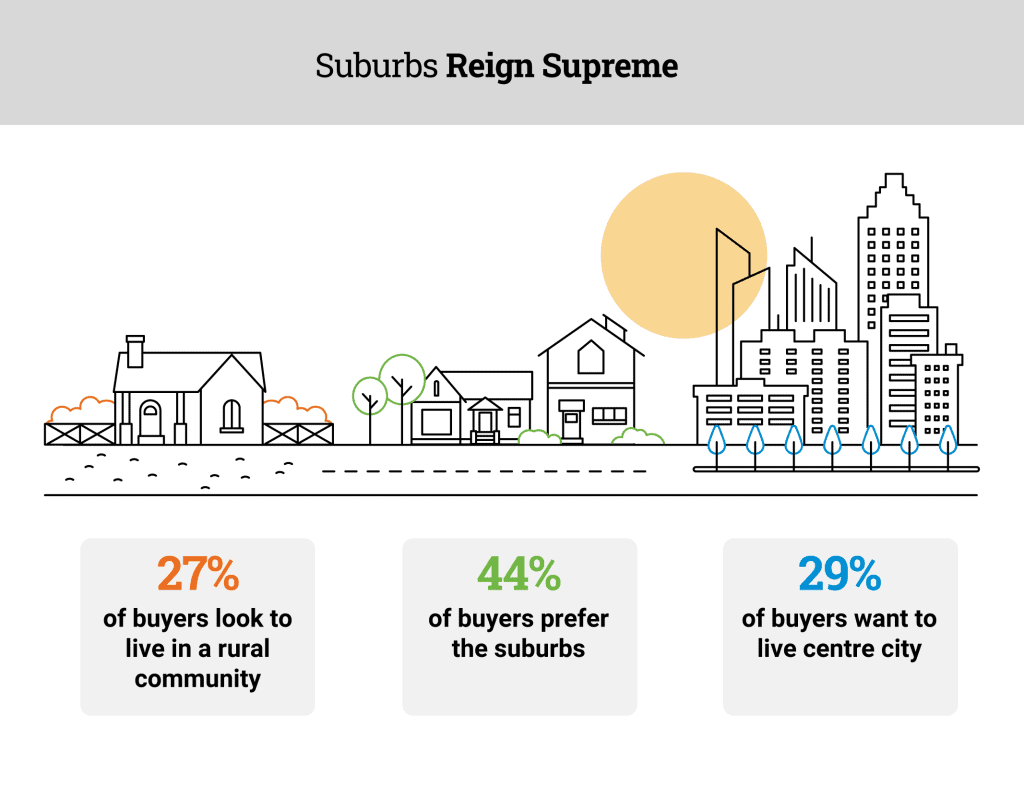
In 2022, the preference for larger homes and increased living space during the pandemic caused a significant boom in house prices in Canada’s suburbs. As remote work became more common, homebuyers opted for suburban areas, offering more square footage at a reasonable price point. Sellers can feel confident that the demand is there if they plan to sell their suburban homes.
This mass migration from urban areas led to a surge in demand for properties outside city centres. Because of this, the gap in real estate prices between downtown areas and suburbs continues to shrink. In 2016, suburban homes sold for 33% less than downtown properties. In 2021, that gap shrank to 10% — meaning that suburban homes are becoming increasingly popular.
And although many workplaces have returned to their full in-house operation or adopted hybrid work models, the Bank of Canada (BOC) cautioned that if the preference for larger homes in suburban areas proved temporary, housing prices in the suburbs could face downward pressure. If our survey respondents have their way, the BOC could be wrong.
This is an advantage for sellers today, as the demand for properties in suburban areas presents a favourable opportunity. However, knowing all of this, there are a few parts of the home that sellers should consider keeping in mind as they list their homes.
Unlocking the Key Features to Focus on as a Seller
When exploring the ideal home for many buyers, most respondents desire a three-bedroom, two-bathroom home — a downsize compared to Zolo’s 2022 results in a similar survey. In the past, buyers were keen on four-bedroom, three-bathroom homes. However, this year, smaller home sizes seem to be something homebuyers are willing to accept, likely due to affordability and manageability.

Must-Have Features or Best Renovations Sellers Can Make
- Main floor bathroom (54%)
- Updated kitchen (45%)
- Patio, deck or outdoor space (50%)
- Garage (48%)
- Updated HVAC (46%)
- Natural light (53%)
Among these features, hardwood flooring still reigns supreme. 69% of homebuyers prefer this over carpet (23%), tile (28%), laminate (17%) and luxury vinyl plank (13%).
To maximize a property in the eyes of a buyer, sellers should consider incorporating a main floor bathroom in good condition. This feature enhances convenience and accessibility, particularly for those with mobility challenges or families with elderly members.
Updating the kitchen is another critical focus area; this is nothing new. Homebuyers have always loved a good kitchen. A modern and well-designed kitchen can add significant value to the home and typically serves as a central gathering space for family and friends.
In addition to indoor features, sellers should also prioritize their outdoor spaces. For example, 50% of buyers favour a patio, deck, or outdoor space. Because they’re giving up space inside with fewer bedrooms and bathrooms, having a place to soak up the sun, relax, and host gatherings is critical.
In addition, a garage (48%), updated HVAC system (46%) and ample natural light (53%) are precious to buyers, as they contribute to comfort, energy efficiency, and a pleasant living environment.
If you plan to sell your home, keep these features in mind, and consider how you’ll present them in a showing. Prepping your home for sale is important, but buyers do not value all steps equally. For example, potential buyers feel that staging and the exterior design are somewhat necessary, whereas cleanliness is extremely important.
Features Sellers Shouldn’t Prioritize
On the other hand, sellers must be aware of the features buyers don’t care about and focus their energy elsewhere. This will help make the property stand out in a competitive market.
The least important features include:
- Mudroom (27%)
- Hot tub (32%)
- Pool (34%)
- Basement suite (21%)
Bungalows and Victorians Remain Popular, but Contemporary Style Takes the Lead
Among the features Canadian homebuyers want, the type of homes we love is changing. Contemporary style is gaining popularity among homebuyers. These styles of homes have clean lines, are minimalistic, and integrate many modern materials. In other words, contemporary homes represent a departure from traditional designs.
On the other hand, bungalows’ distinct architectural style came around in the early 20th century. These single-story houses typically have a low-profile design. They usually have a front porch and a simple yet charming aesthetic. In addition, bungalows are known for their efficient use of space and functional floor plans — creating a seamless flow between rooms.
A bit the opposite, victorian style homes showcase a mix of architectural influences. They usually have ornate trim, intricate woodwork, and decorative elements such as gingerbread detailing, stained glass windows, and intricate fretwork.

However, their connection to the outdoors and ability to draw in natural light through oversized windows aligns with all three home styles. This makes sense because natural light is a must-have for 53% of buyers. Therefore, maximizing natural light and indoor-outdoor connectivity is crucial no matter what style of home buyers prefer.
Ultimately, the appeal of these architectural styles lies in their ability to create a sense of identity, reflect personal tastes, and capture the spirit of a particular era.
66% of Canadians Say Home Price is a Deal Breaker
When purchasing a home, it’s no surprise that the price plays a significant role in decision-making. A staggering 66% of Canadians consider home price a deal breaker. Likely this is because, for many Canadians, homeownership still seems out of reach. A recent Mortgage Professionals Canada (MPC) survey found that a record high (33%) percentage of Canadians believe they’ll never be able to afford a home.
“The number one deal breaker in anything is usually price,” says Nick Hill, the Canadian Real Estate Investor podcast host. “We have too many people that need housing and not enough houses,” Hill says this guarantees available housing becomes more expensive.
Is Price the Only Factor?
But, generationally, Gen Z is the only group to give the price a backseat when considering their home purchase. Instead, the home’s condition is what matters. A home’s condition is another important dealbreaker for many buyers, with 61% of respondents highlighting this as a primary concern.
“Gen Z’s mentality around homes is unlike that of Millennials and Boomers,” says Hill. “The ones buying homes seem to want to focus their efforts on other things and want their property to be turn-key, and are apparently willing to pay for it.”
Buyers are often looking for a well-maintained and move-in-ready home. As a result, buyers are ready to walk away when they do a walkthrough and start noticing issues such as structural problems or the need for extensive repairs.
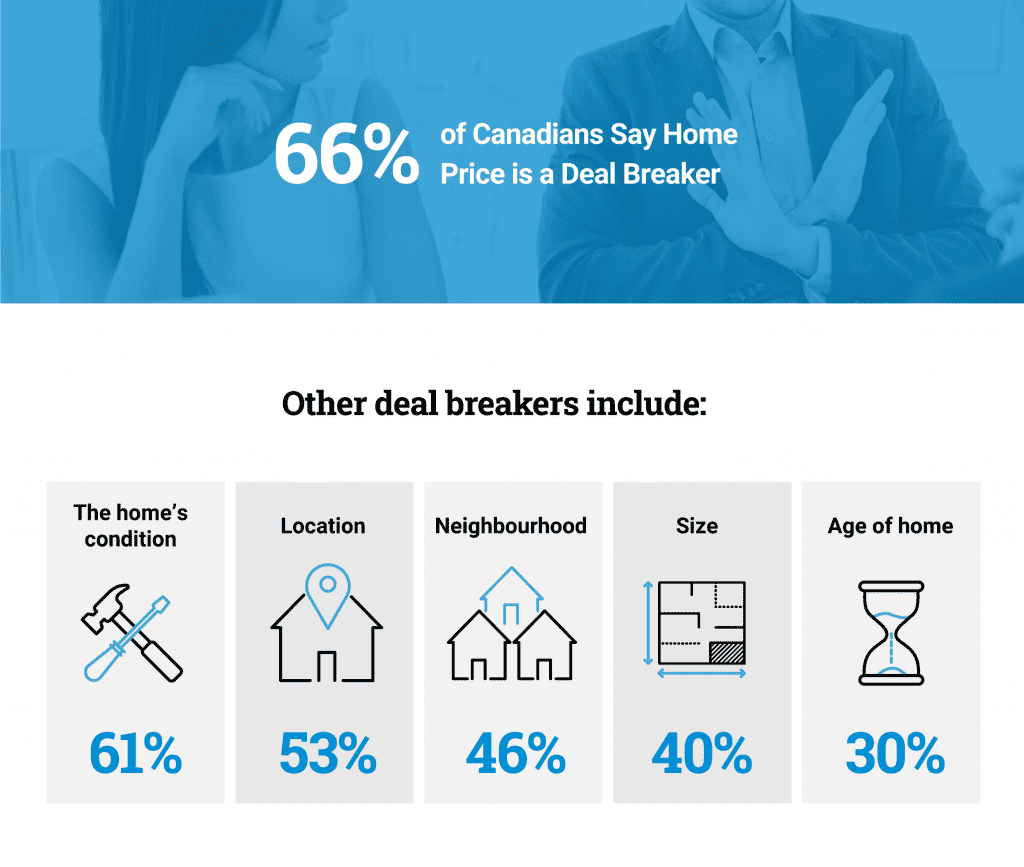
68% of Canadians say a home’s overall condition is extremely important when purchasing a home. This is because 47% of buyers are only willing to do minor cosmetic upgrades to a home — such as painting or updating fixtures. Only 32% are eager to do more substantial renovations and upgrades, such as a roof or foundational repair.
Location is another crucial factor that can deter potential buyers. When looking at the neighbourhood’s reputation, proximity to amenities, schools, and transportation, these can all impact our choice. For example, if the area doesn’t feel safe and clean and has accessible amenities, buyers will reconsider their purchase.
Medical Facilities: A Vital Must-Have for Homebuyers
Regarding amenities, the top pick for Canadian homebuyers is parks and outdoor recreation, with 64% of respondents choosing this as their must-have. The other two top amenities are shopping and dining (63%) and medical facilities (50%).
“A running theme throughout this survey is Canadians’ deep desire for finding ways to incorporate the outdoors into their living space and lives,” says Jordann Kaye, spokesperson for Zolo. “It makes sense given that Canadians historically value outdoor activities, a trend that was amplified during the pandemic.”
It also makes sense that most homebuyers prioritize medical facilities in neighbourhood amenities. A recent Angus Reid Institute poll found that nine million Canadians have ‘chronic difficulty’ accessing healthcare.

The top three amenities show Canadians are much more aware of their need for balance. The convergence of outdoor leisure, an ability to experience good dining and convenient shopping, and a desire for accessible healthcare make this clear.
Generational Differences in What Home Buyers Want
When it comes to generations, comparing the needs and wants of homebuyers in each age group is essential — and although there are some noticeable differences — most feel strongly about the same parts of homebuying.

Gen Z, Millennials, Gen X and Boomers want to live in single-family homes. Most are also equally happy with their three-bedroom, two-bathroom suburban dream home. But Gen Z wants a bit more space with one extra bedroom. Of course, we already know that aside from Gen Z, everyone agrees that price is the number one dealbreaker. But, the generations differ in their home style preferences and which amenities are most important.
Boomers and Gen X are both into bungalows with open and flowing floorplans. Gen Z is looking for something more modern in its contemporary style. But on the flip side, Millennials stand out with their interest in colonial homes — a symmetrical two-story house with a center entrance and evenly spaced windows on either side. As for amenities, Gen Z and Boomers want shopping and dining, whereas Millennials and Gen X crave good parks and outdoor recreation.
While the desire for single-family homes and the preference for the suburbs remains strong across generations, the variations lie in style preferences and preferred amenities. Understanding these nuances in preferences can help buyers and sellers navigate the real estate market with greater insight and tailor their choices to meet the specific desires of each generation.
Homebuyers Okay with Less, as the Ideal House Size Is Shrinking
What Canadian home buyers want is primarily shaped by the desire for single-family suburban homes, despite the price of these homes in most major cities. As of April 2023, the average home price in Canada sits at $716,083. In contrast, the average salary of Canadians is $59,059. This is likely why home buyers are okay with less, and we’re slowly seeing the ideal house size shrinking.
Buyers are willing to downsize and prioritize amenities and outdoor spaces. With this in mind, it’s still important to acknowledge that key features such as a main floor bathroom, an updated kitchen, and ample natural light are important to buyers. As are the price, home condition, and location.
If you plan to buy or sell a home in 2023, understanding these preferences will help you make better decisions in a continually evolving real estate market.
Survey Details
The survey data for What Home Buyers Want 2023 was collected online from May 4, 2023, to May 5, 2023.
The online survey asked 800 respondents a variety of opinion, self-report and knowledge-based questions to measure what features are most important to them and their views today based on the current economic situation and real estate market.
The estimated margin of error is +/- 3 percentage points.