This year has proved to be a challenging one for Canadians. A recent Equifax Canada consumer survey found that the average credit card balance has reached a historical high of $2,121. With this news, the Bank of Canada, and many economists alluding to continual increases in interest rates over the next few months, Canadians must prioritize their debt.
To help you get on track for 2023, we asked personal finance experts for advice on the biggest challenge facing Canadians: paying off debt. We’re sharing their tips on getting out of debt, enjoying better financial health, and boosting your financial literacy.
Tips to Help You Get Out of Debt

Debt, especially high-interest debt, has the potential to impact many areas of your life negatively. For example, suppose you’re dedicating a portion of your earnings towards paying down debt. In that case, debt repayment can impede your progress on any other financial goal.
It’s hard to save for a home, major purchase, or emergencies if a portion of each paycheque goes to debt. Being debt-free allows you to channel those funds toward your next financial objective and increases your chances of achieving it.
Debt can also impact your credit score. We don’t mean that having any debt automatically equals poor credit, though. Carrying high debt relative to your credit limits and missing monthly payments will tank your credit score. Poor credit is difficult to rebuild, and bad credit will prevent you from getting access to competitive interest rates.
In short, out-of-control debt snowballs your finances, making every aspect of your financial life challenging. Whether you are trying to qualify for competitive interest rates on your mortgage, applying for an apartment rental, or landing your dream job, having your finances in order will make your life easier.
In addition to the impact on your overall financial health and credit score, managing debt can be stressful. Many Canadians report that their debt significantly affects their mental and emotional well-being.
Use these tips from industry experts to take control of your debt and work towards achieving your financial goals.
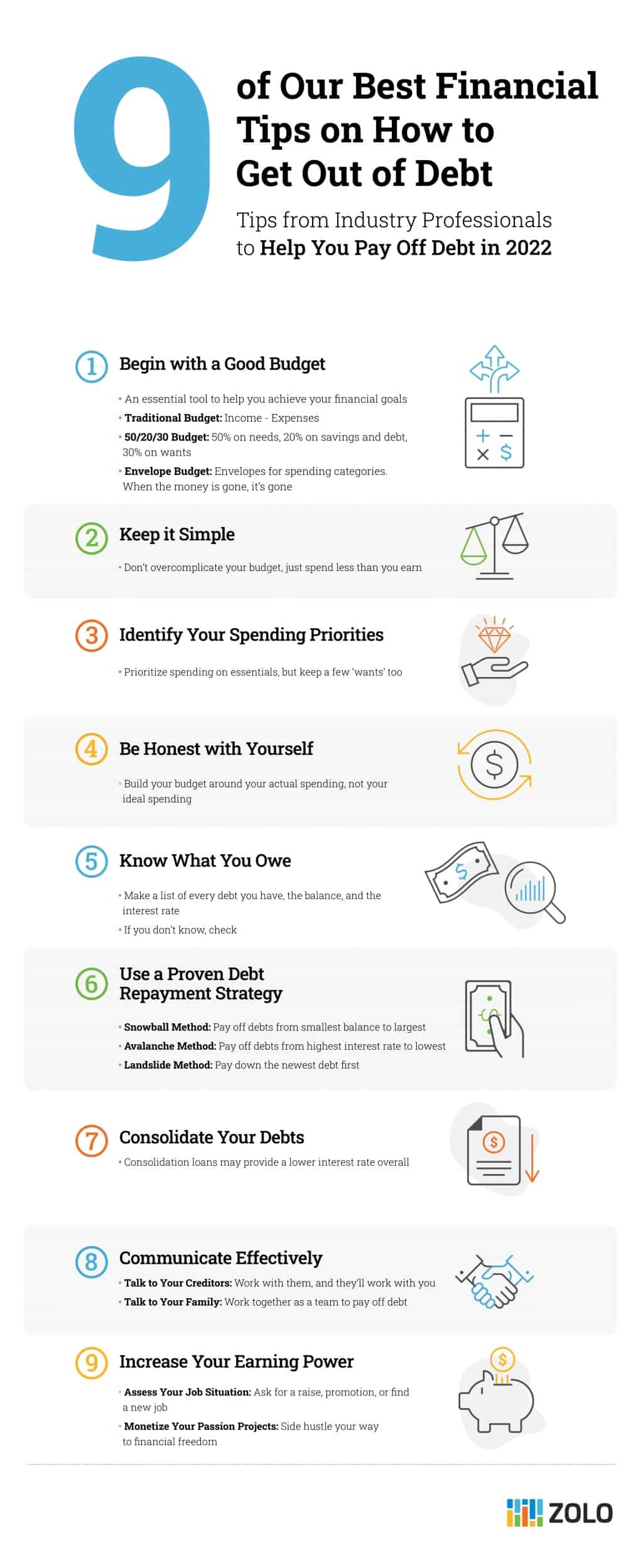
1. Begin With a Good Budget

A budget is an essential tool for helping you achieve your financial goals. A budget is both a comprehensive map and a mile marker, giving you a snapshot of your current financial situation, showing you the way toward your goals, and helping you track your progress.
There are many different ways to create a budget, so it’s crucial to find one that works for you. Remember, a reasonable budget aims to align your spending and goals, in this case, debt repayment.
Some budgeting methods are:
- Traditional Budget: A classic budget involves listing your expenses in a spreadsheet or app and comparing them to your income. This method typically contains a detailed spending list and allows you to customize each category easily.
- 50/20/30 Budget: This method works well for people interested in the bigger picture. You’ll divide your expenses into three categories: needs, savings, and wants. You’ll spend 50% of your total income on needs, 20% on savings and debt, and 30% on wants.
- Envelope Budget: This strategy is ideal for people who tend to overspend. Each month, you’ll allocate a certain amount of cash to each area of your budget. Once the money in any particular category is gone, it’s gone. This strategy can be tricky for people who prefer not to carry cash. In that case, you can substitute the envelopes for savings accounts.
In addition to giving you a clear strategy for paying down debt, a budget can also help you stay debt-free.
2. Consider Your Money Relationship
Mark Seed of My Own Advisor says that debt management is not just about spending or overspending. It’s about changing your behaviour and relationship with money. He encourages people to be curious:
- Do you shop for groceries without a list?
- Do you do takeout dinner because it’s just easy?
“Habits are hard to break or change, and any habits can have an impact on your bank account,” says Seed. “I would suggest taking some time to understand your habits and consider where savings could be found if you cut out various behaviours.” He says that could be cancelling memberships you don’t use, cutting out takeout once in a while, or avoiding the latest iPhone for a few years. “While routines and habits can be good, they can also be financially wasteful,” says Seed.
3. Take Inventory of Your Debt
The key to creating a budget you can stick with is to make it intuitive, accessible, and straightforward.
“Start by establishing your baseline and track it over time,” says Jessica from Canadian Budget. “By this, I mean you need to know where you are today to start,” Jessica says that may mean you have to stare some pretty scary things in the face, like opening your long ignored bills, writing down all the total amounts owing, and the interest rates of each of your debts.
“Don’t forget to include the debts that don’t come with bills, like money owed to family and friends,” she says. “This will give you a picture of where you stand today. Don’t let this number define you or get you down. It’s just a point in time, and starting today, you are taking charge to positively impact your debt.”
You should also find a budgeting mechanism that is easy to use and gives a clear picture of your finances. Many free and paid apps help you create an effective budget. We like Mint, YNAB, and PocketGuard.
4. Give Yourself Grace
Paying off debt can feel like a long and strenous journey. “To keep yourself motivated on your debt repayment journey, add milestone to celebrate and reward yourself,” says Parween Mander, money coach.
She shares an example in which you have $3,000 of credit card debt. “Every $1,000 you pay off make sure to pause and celebrate and treat yourself,” says Mander. “This could look like grabbing your favorite coffee and pastry, that Sephora lipstick you’ve had your eye on, a really nice dinner at a local restaurent.” She says it’s so important we don’t deprive ourselves of spending on things we enjoy because we’re on a debt pay off journey.
Mander says we need to remove the narratives like “you can’t eat out if you have debt” or “you can’t buy new clothes or make up because you have debt”. “When we keep shaming and telling ourselves we “can’t or shouldn’t” we set ourselves up for failure.”
5. Be Honest With Yourself
When it comes to budgeting, CEO Timothy Hansen from Wealth Growth Wisdom LLC says that honesty is critical. “Track what you actually spend, not what you think you should be spending, for a month. If you aren’t honest with yourself in this exercise, it won’t work,” Hansen advises. “Once you know your spending habits, you should be able to identify areas where you can cut back.”
It’s also essential to hold yourself accountable. For example, journaling about your expenditures can help you keep a record of where you’re spending money. Another accountability tool is a prepaid card. Using this card for your daily expenses can help provide a clear picture of where your money goes.
6. Know What You Owe
Knowledge is power when it comes to tackling debt, says David Cusick of House Method. “The first thing you need to do is get your credit report and find out how much you owe on each debt,” Cusick says. He also mentions that although most people assume they know the amount of an outstanding balance, they often over or underestimate it.
A credit report will contain details like the exact amount owed, the interest rate, and the minimum payments required. Getting a clear picture of your debts can help you decide the most effective strategy for paying them down.
7. Use a Proven Debt Repayment Strategy

Now that you know how much you owe and to whom, you’ll need to decide how to start paying down your debt. Again, eliminating debt in a systematic way will get results and show clear progress.
There are many different methods recommended by industry professionals, each with unique benefits. We’ve covered three here: the snowball method, the avalanche method, and the landslide method.
The Snowball Method
The snowball method organizes your credit accounts from the smallest balance to the greatest, explains Matt Frankel, personal finance advisor with The Ascent. “When you get paid, make the minimum payments on all of your accounts, except the smallest, which you’ll pay down as aggressively as possible, Frankel says. “Once that account is paid in full, move on to the next smallest. The idea is that instead of feeling like you’re just paying all of your accounts forever, you’ll see your debt eliminated one by one.”
Adem Selita, CEO and co-founder of The Debt Relief Company, recommends this method if you feel like you’re not making much progress with paying down debt. “It reinforces and rewards you psychologically once each balance disappears and makes managing your finances more convenient as you get rid of required minimum payments altogether.”
The Avalanche Method
Nicole Victoria of No Budget Babe suggests the avalanche method if you’re looking to save more money in interest over time while paying off debt. She shares the acronym ICE to help you remember, which stands for: illuminate, cut costs and earn. “This sheds light onto where you’re at with your debt,” says Victoria. “Make a list of what you owe, who you owe it to, your minimum payment, and your interest rate, and then list them from the highest to the lowest interest rate.” Victoria says this is the order you will pay them off.
Using this method, you pay the minimum on lower-interest debts and direct all your extra cash to the debt with the highest interest rate. Putting all your extra money towards one debt will eliminate it quickly, minimizing interest. Then, repeat these steps until you’ve paid your balances in full.
The Landslide Method
If you’re looking for a debt repayment method that may help rebuild your credit more quickly, Todd Christensen of Money Fit recommends the landslide method. “Instead of focusing your debt repayment on the account with the highest annual percentage rate (the avalanche method) or the lowest balance (the snowball method), focus all additional debt repayment funds on paying down your newest debt account first,” Christensen says.
Since many credit score calculations attempt to predict future payments based on recent behaviour, focusing on repaying the newest debts can allow you to rebuild credit more quickly.
Combine a Few Methods
Zandile Chiwanza, financial wellness educator, says that while the two most popular methods for getting out of debt are the avalanche and snowball method, don’t be afraid to take a blended approach.
“For instance, I chose to pay off my most emotionally-heavy debt first even though it had the lowest interest rate and then implemented the debt avalanche method once I got that out of the way,” says Chiwanza. “You have to decide which debt payoff strategy is right for you based on your needs and goals.”
8. Consolidate Your Debts
It can be difficult and overwhelming to manage several different debts separately, says Anna Barker of LogicalDollar. If you’re currently juggling several debts, she recommends you consider consolidating them. Consolidating your debt combines many debts into one, which makes the repayment process more manageable.
“This also has the added bonus of often allowing you to take advantage of a lower interest rate,” Barker says. “In doing this, you can save yourself thousands of dollars in interest while also helping you to pay off this debt much faster than you would have otherwise been able to do.”
Before you opt for debt consolidation, be sure to do your research and find a reputable organization. They will work with you to find the right solution for your situation. You’ll also need to consider factors like interest rate and timeline to ensure your plan includes the shortest period and lowest interest rate.
It’s also important to know that some debt consolidation options work like bankruptcy and can negatively affect your credit score. A reputable company should go through all of these factors with you and answer any questions.
9. Attack the Debt Head On
It’s essential to gather information when it comes to paying down debt. But it’s also important to be candid when talking to creditors and family. “Attacking the debt that causes you the most stress has a positive snowball effect,” says Catherine Lê, financial advisor. “I often find with my clients that our emotions are intertwined with our finances.”
Lê says that things that cause stress and anxiety will almost always override logic and reasoning. “How can we harness that and turn it towards something productive?” says Lê. “Well, first we need to name it, then we can address it.”
Talk to Your Creditors
Negotiating is a great way to help you get out of debt. “The worst-case scenario is that your request is denied,” says Bella Wanana. “But the potential benefit of someone saying “yes” significantly outweighs the little time you spent on the phone.” Wanana says that if you have credit card debt, call the company and see if they could lower your interest rate.
“If you have a mortgage, check and see if you could reduce your mortgage rate or if your phone bill is too high, call your service provider and see if there is anything they can do about it.”
Suppose you’re anxious about speaking with creditors or aren’t sure about your rights. In that case, the Canadian government offers a fantastic resource on debt collection to prepare yourself. “Whatever the case may be, don’t assume that you can’t do anything about it,” says Wanana. “It’s better to be told “no” by someone than giving up the possible savings you can get through negotiating.”
Talk to Someone You Trust
Speaking about money can feel overwhelming. “So many of us are suffering in silence because we are ashamed of our situation or terrified how our best efforts may be perceived,” says Jessie Orok of Wealth, Health, Home. “The truth is, there is so much support and resources available in the community that you may be missing out on because you think you need to struggle alone.” Orok says that sometimes all you need is a listening ear, an extra set of eyes or a guided path to help your journey feel less scary.
10. Increase Your Earning Power

So far, we’ve looked at strategies mainly for managing debt based on your current income. But another way to tackle debt is to find ways to boost your earnings, even temporarily. You can then channel this extra income directly to paying down outstanding balances.
Assess Your Job Situation
Sam Hawrylack, personal finance expert and co-founder of How to FIRE, recommends looking at your current employment to see if there’s any way to augment your income. “This could mean working overtime at your job or finding a side hustle you enjoy working during your off-hours,” she says.
Finding a new opportunity or additional part-time job can help you develop valuable skills while improving your financial health.
Monetize Your Passion Projects
If you’ve got a skill that’s outside your current job duties, long-time business owner Matt Scott suggests taking steps to monetize it. “By capitalizing on a passion you love, or an ability set you may have, you might even try raising any additional money to pay off your debt,” Scott says. “Try selling your crafts on Etsy if you are crafty. See if you can pick up any extra work if you’re a handyman.” He also suggests freelance activities like contributing to publications or professional platforms if you are a successful writer.
The Bottom Line: To Get Out of Debt, You Just Need to Start
The nine tips above might seem overwhelming, especially if you want to implement them all, right away. In that case, our best advice is to start small, implementing just one of these tips at a time. If you find yourself trying to do it all, you may stretch your resources too thin and be tempted to quit. By tackling one tip at a time, you’ll start yourself down the road to financial prosperity.