
Buying a house when you’re single is tricky, especially in Canada, where market prices are higher than most. In addition, homeownership rates continue to increase while wages stay stagnant. Despite this, the number of people buying properties with a partner or spouse has also steadily declined. This shows that joint incomes aren’t needed to purchase a home, and financial independence can be anyone’s game in home buying.
To support single buyers looking to purchase a home independently, we’ve ranked the top places in Canada for buying a home as a single person. We looked at several factors to determine which cities are the best for single home buyers, including
- Average housing prices
- Number of one-person households
- After-tax income
- Unemployment rates
- Population growth rates
Using this information, we uncovered the best cities for single home buyers. We also understand that buying a home on a single income can be tricky. And right now, there aren’t many cities or areas that allow homeowners to purchase property solo. We also acknowledge that most single buyers aren’t purchasing a traditional detached home. To make this list as useful as possible, we included the average price for apartments and townhomes for the top cities for singles in Canada.
Best Places in Canada to Buy a Home as a Single Person
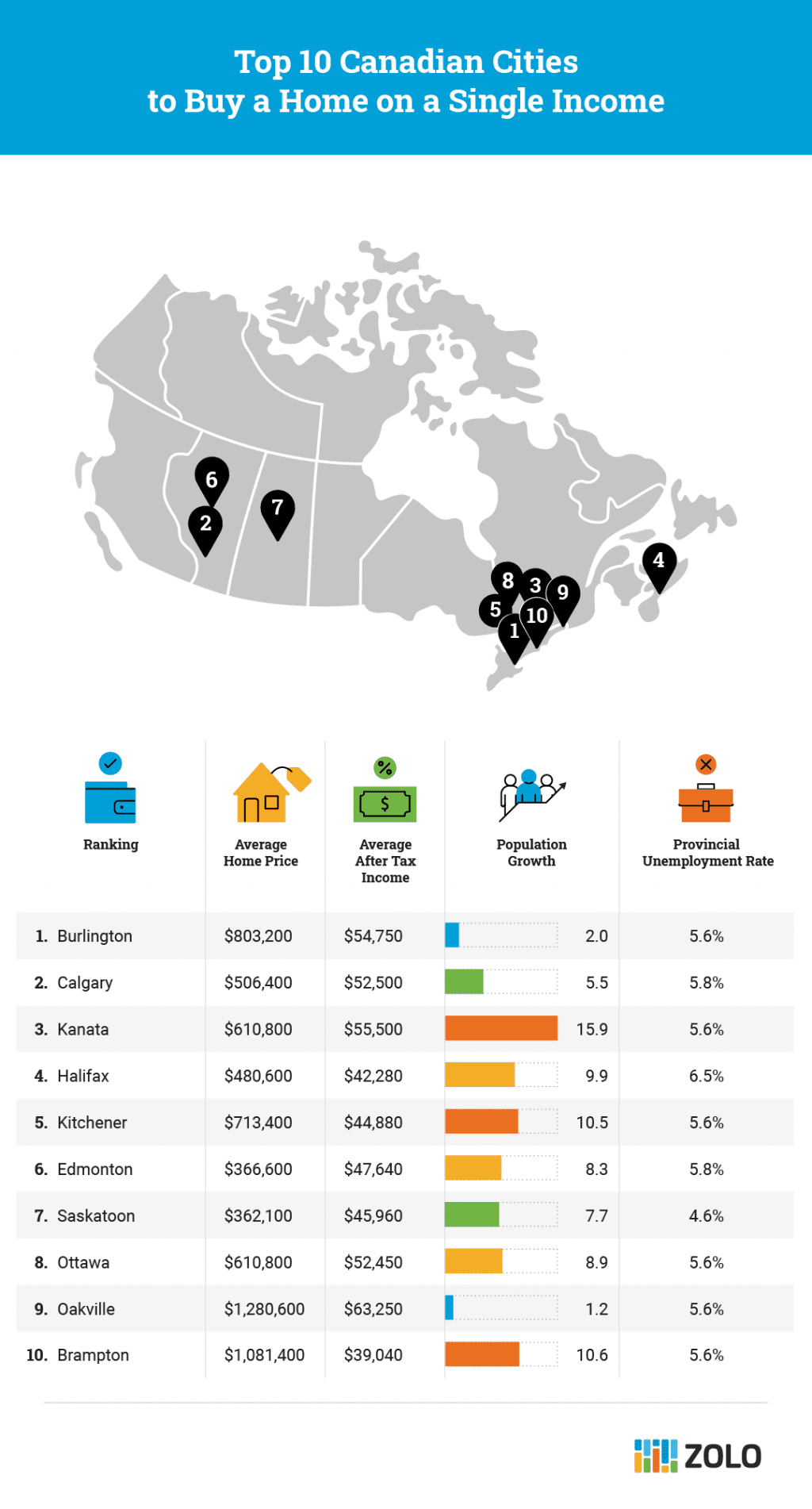
We compared the average home prices for the top 25 most populated areas in Canada (cities with a population of 100,000 or more). This list only includes cities with current data available to ensure all compiled data is accurate and timely.
We then pulled supportive data to determine the average home price and an individual’s ability to afford a home as a single household. We also felt it matters to consider the city’s demographics, such as single population, employment opportunities, and population growth.
Why More Canadians Are Living Alone

So what’s causing so many singles to live and purchase property independently? Due to advances in career opportunities, changes in attitudes toward family structure and increases in financial independence, the typical household is transforming and catering to a single lifestyle. Let’s explore additional factors below.
More Canadians Are Waiting to Have Kids and Getting Divorced
More single people living in Canada have children at an older age. This, or they previously had a child in a common-law marriage and are now separated. Also, almost half of solo dwellers ages 35 to 64 have been separated or divorced in the last 20 years.
The Pursuit of Higher Education Is Changing the Family Structure
Another factor comes from a more flexible attitude toward the family structure. A report by Statistics Canada highlighted a change in society, as fewer singles define adulthood with marriage. This is primarily as more young people pursue higher education. Among women ages 25 to 34, more than three-quarters (77%) of those who live alone have a university degree, compared to 67% of those who live with others, the report found. The study also found a correlation between higher education, getting married and starting families at later ages.
There’s no doubt that these trends have impacted the housing market. For example, we’ve seen a spike in solo dwellers residing in condominiums, which is an easier way to buy a home on a single income, coinciding with the rising demand for individual living quarters.
The 5 Best Places in Canada for Single Home Buyers
1. Burlington
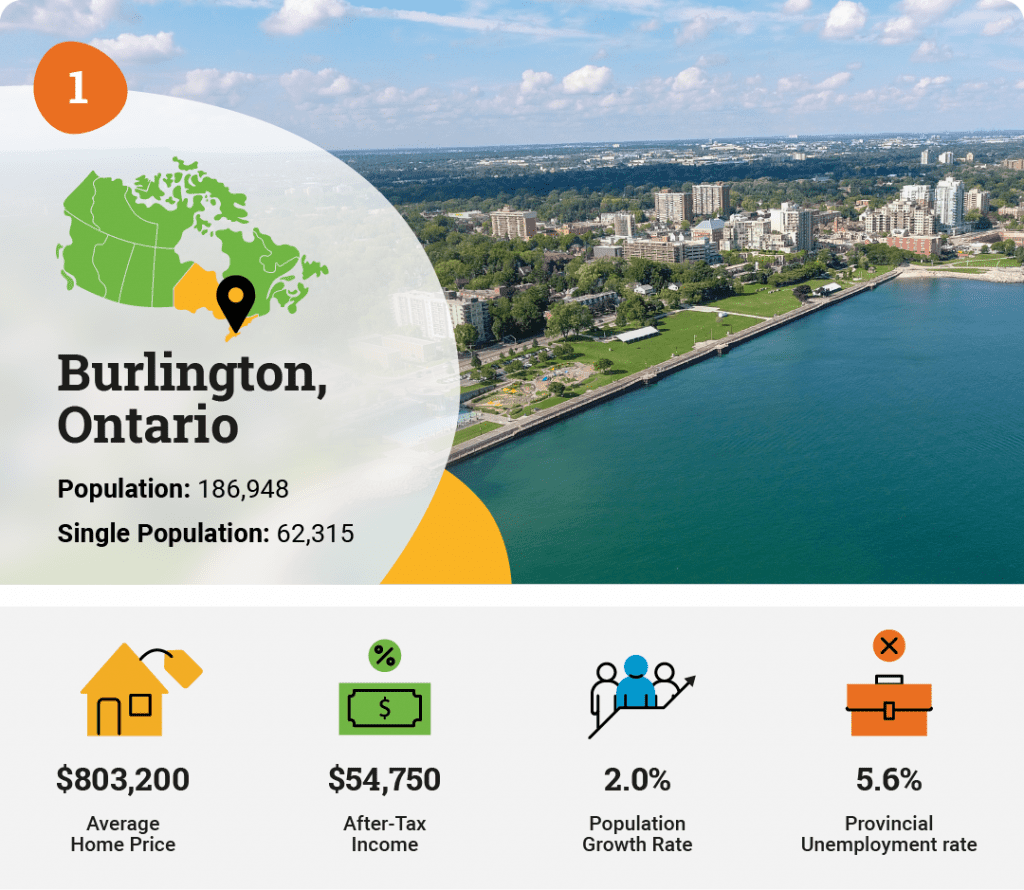
Located between Toronto and Niagara Falls, Ontario, Burlington is on the shores of Lake Ontario. It’s a perfect place for nature lovers who want to be close to the big city of Toronto.
Burlington has fewer than 200,000 people. For that reason, it’s ranked as one of Canada’s Best Small Cities, where its low crime rate shone. If you love green spaces, there is plenty of that in the city, from the Burlington Waterfront Trail to the Royal Botanical Gardens. Although it’s a small city, there are plenty of restaurants and summer festivals to attend. The popular Taste of Burlington hosts events twice yearly, so you can experience the many great local restaurants and bars.
Burlington offers public transit and a recently expanded hospital. In addition, there are plenty of opportunities for shopping and other amenities, including a mall, local boutiques, Ikea, Costco and more.
If you work in Toronto, it is easily accessible via the GO train from Burlington, which takes about an hour. There are also several opportunities for employment within different sectors in the city. If you like to travel, Burlington is a short 30-minute drive to Toronto Pearson International Airport or a 25-minute drive to John C. Munro Hamilton International Airport.
How Much Do Apartments and Townhomes Cost?
- Average apartment cost: $549,900
- Average townhome cost: $664,500
Typically, you can afford a mortgage in which your monthly household costs are less than 32% of your gross household income and your debt comes to less than 40% of your gross income. Using this calculation and a down payment of 10%, you would need an income of at least $129,795 to buy a townhome in Burlington.
2. Calgary
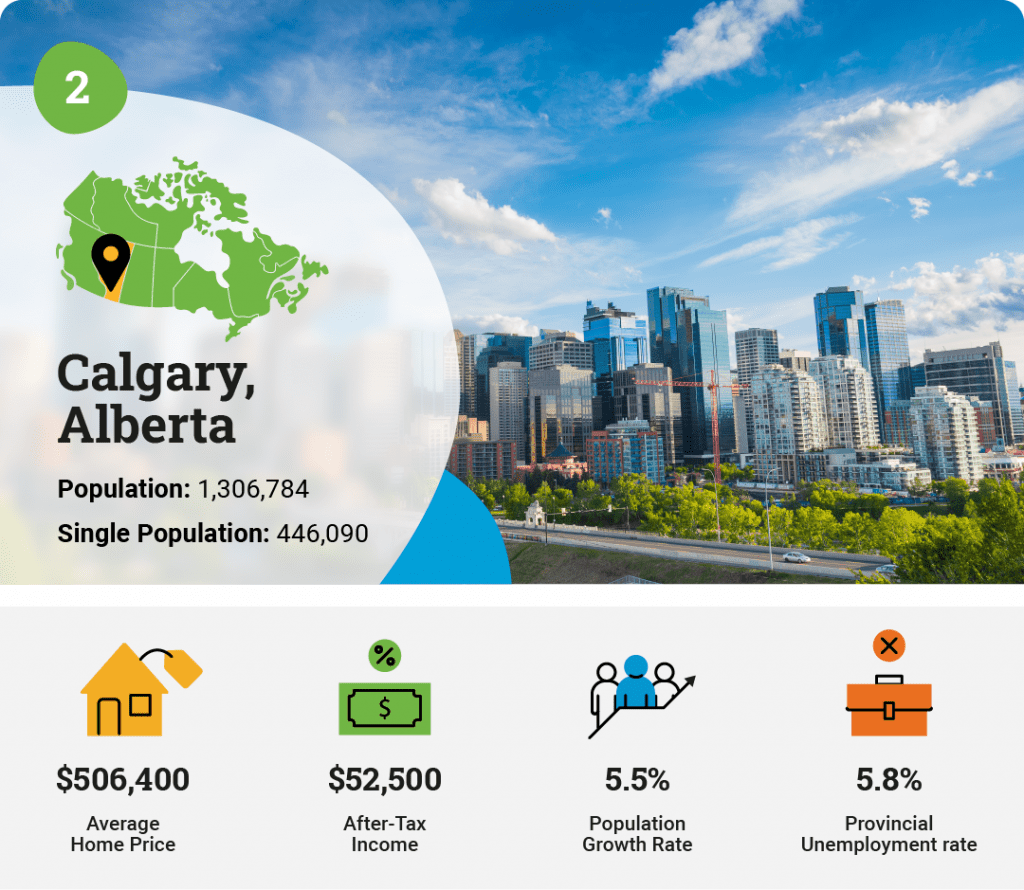
Welcome to Calgary, Alberta, a laid-back city ranked the fourth best city to live in the world in 2022, according to the Global Liveability Index. Calgary is a youthful city in the foothills of the Rocky Mountains. The median age is just 38 years old, and the city boasts two major universities. This city of 1.3 million people is home to many world-class festivals, including the Calgary Stampede, which brings over a million to the 10-day event.
The city offers affordable public transportation, many restaurants, bars, cafes, shopping, museums, an international airport, major sporting events and concerts, and so many more things to do.
Calgary is the home base for many major companies in Canada, providing many employment opportunities across many different sectors. It also has a low sales tax, only 5%, so doing your shopping in Alberta can save you money in the long run!
If you’re a nature lover, there are many urban parks throughout the city, plus over 1,000 km of multi-use pathways for walking, biking, or cycling. In addition, you are less than a 90-minute drive from Banff, home to world-class skiing, snowboarding, hiking, and camping. And if you needed another reason to love Calgary, it is the sunniest major city in Canada, with an average of 333 sunny days per year!
How Much Do Apartments and Townhomes Cost?
- Average apartment cost: $286,200
- Average townhome cost: $388,200
Typically, you can afford a mortgage in which your monthly household costs are less than 32% of your gross household income, and your debt comes to less than 40% of your gross income. Using this calculation and a down payment of 10%, you would need an income of at least $75,796 to buy a townhome in Calgary.
3. Kanata
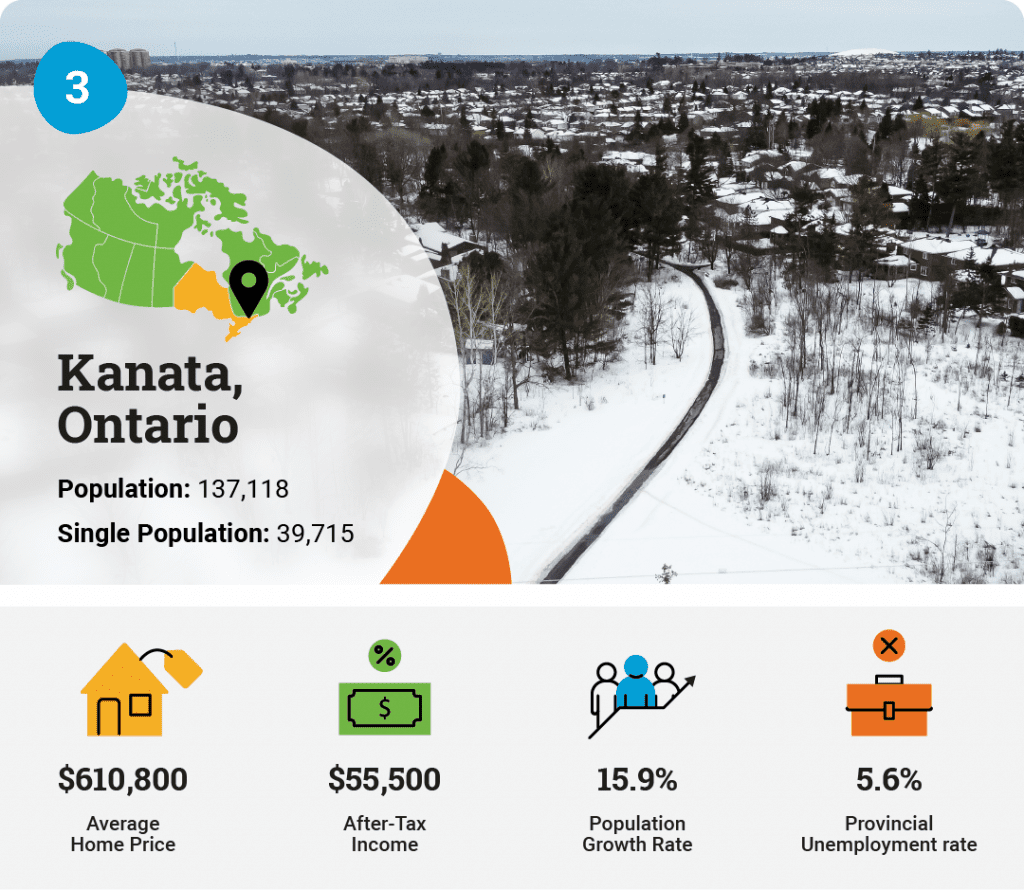
You’ll find the suburb of Kanata just west of Ottawa’s downtown core. With just over 137,000, it is one of Ottawa’s fastest-growing neighbourhoods. Just because it is a suburb doesn’t mean there is nothing to do! Kanata is also home to many restaurants and bars, a large shopping mall, Kanata Centrum, a Tanger outlet mall, and big box retailers like Walmart, Canadian Tire and more. The Canadian Tire Centre Arena, home of the Ottawa Senators NHL team, is located in Kanata. The venue also hosts world-class concerts, comedy acts and other sporting events.
Kanata has public transportation options to go into Ottawa’s downtown core. The suburb is home to Canada’s most prominent tech park, employing in many tech sectors. However, if you work in downtown Ottawa, the commute is short.
Overall, Kanata is a safe, growing neighbourhood with everything you need to work, live and play while being close to all the amenities and fun Downtown Ottawa offers.
How Much Do Apartments and Townhomes Cost?
- Average apartment cost: $413,900
- Average townhome cost: $464,800
Typically, you can afford a mortgage in which your monthly household costs are less than 32% of your gross household income, and your debt comes to less than 40% of your gross income. Using this calculation and a down payment of 10%, you would need an income of at least $90,694 to buy a townhome in this sizeable Ottawa suburb.
4. Halifax
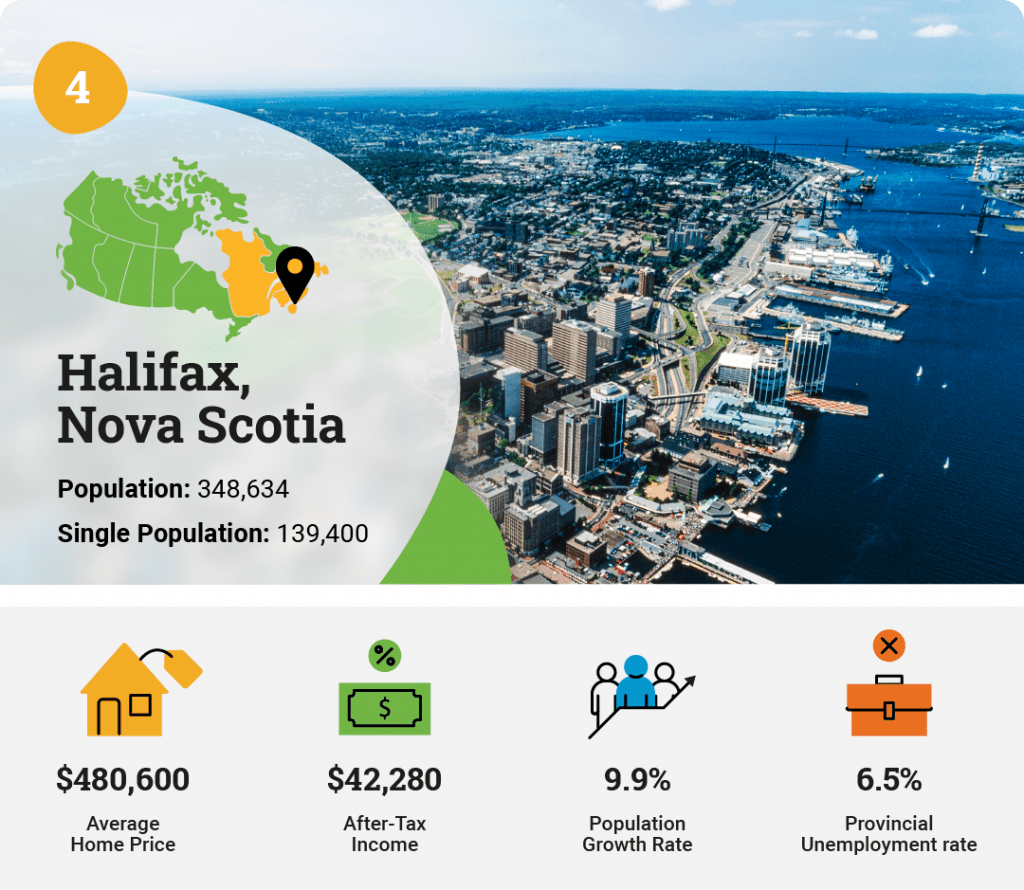
If you’re looking for an East Coast lifestyle in a city, Halifax may fit the bill! The largest city in the Maritime provinces has a lot to offer. The Halifax Regional Municipality has a population of approximately 480,000. The city has been growing significantly over the last few years.
Halifax offers the opportunity to live and work in a city with the ability to see the Atlantic ocean and enjoy nature. The downtown area is walkable but also provides public transportation. There are many bars, restaurants and local breweries. The Scotiabank Centre is home to the QMJHL team, the Halifax Mooseheads, a National Lacrosse League team, and the Halifax Thunderbirds while also hosting concerts, comedy acts and the yearly Royal Nova Scotia International Tattoo.
Being a port city means there are many employment opportunities. Major employers are the Irving Shipyards and the Department of National Defense. In addition, there are several major universities, an international airport and a vibrant arts scene.
There are plenty of ways to enjoy nature. For example, the Halifax Public Gardens and Point Pleasant park offer multi-use trails, and you are a short drive away from many other provincial parks. You’ll find a friendly and safe city in Halifax, where you’re always close to the beach.
How Much Do Apartments and Townhomes Cost?
- Average apartment cost: $428,100
- Average townhome cost: $482,400
Typically, you can afford a mortgage in which your monthly household costs are less than 32% of your gross household income, and your debt comes to less than 40% of your gross income. Using this calculation and a down payment of 10%, you would need an income of at least $94,342 to buy a townhome in Halifax.
5. Kitchener
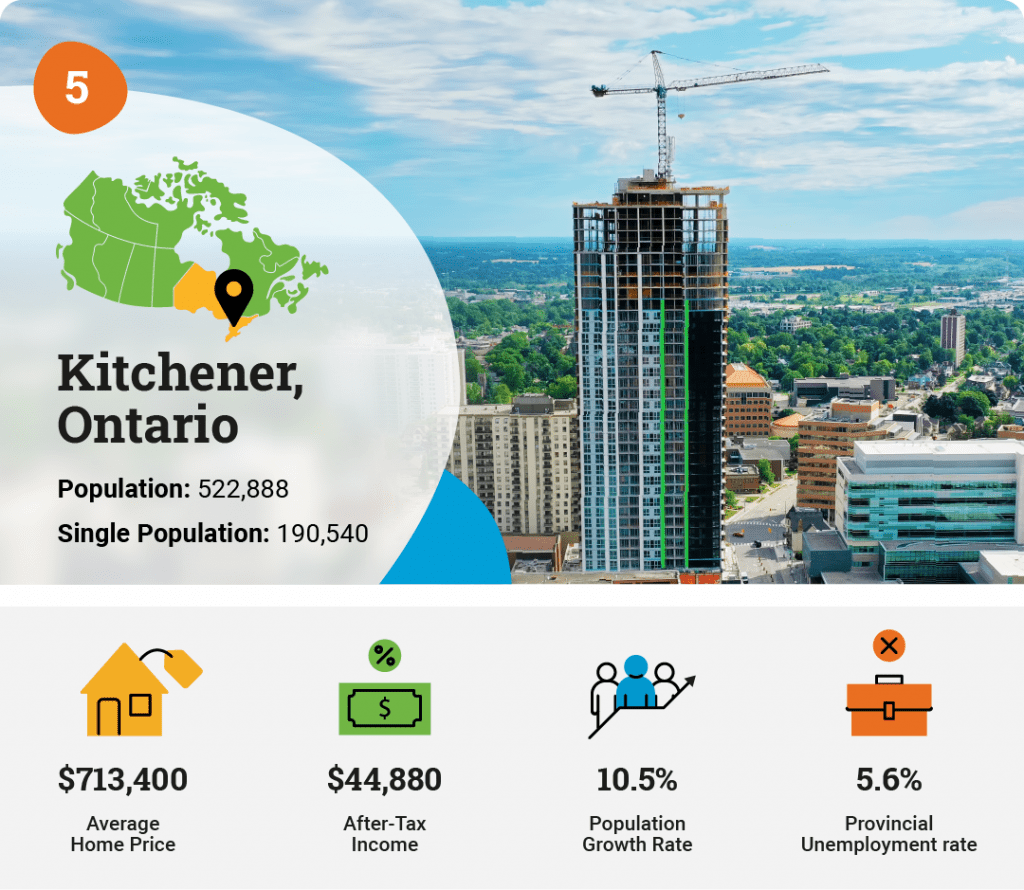
Kitchener, Ontario, with a population of about 240,000, makes up part of the Waterloo area, approximately 100 km west of Toronto.
While it’s not a large city, Kitchener offers a rich cultural experience with a world-class arts theatre, local restaurants and cafes, museums, and more. In addition, Kitchener hosts some of the biggest names in blues every year during the four-day TD Kitchener Blues Festival. The city is also proud of its German heritage. You can celebrate that during the annual Kitchener-Waterloo Oktoberfest, the largest outside of Germany.
Kitchener offers public transportation, including an option to take the train into Toronto, which takes about 90 minutes. The Toronto Pearson International Airport is just under an hour away by car, and the smaller Region of Waterloo International Airport also serves the city.
For nature lovers, you can enjoy Victoria Park, designed by the same people who designed New York’s Central Park. There are also golf options and plenty of hiking and walking trails in the Huron Natural Area.
For employment, Kitchener is known for manufacturing, insurance and high-tech, including being the Canadian home of Google. Kitchener can be the best of both worlds; a small town has many amenities and access to Toronto.
How Much Do Apartments and Townhomes Cost?
- Average apartment cost: $472,000
- Average townhome cost: $594,200
Typically, you can afford a mortgage in which your monthly household costs are less than 32% of your gross household income, and your debt comes to less than 40% of your gross income. Using this calculation and a down payment of 10%, you would need an income of at least $116,188 to buy a townhome in Kitchener.
How Singles Can Get the Most Bang for Their Buck

Approaching the table when you buy a home on a single income can be difficult for many. But those wanting to buy a home on a single income can face even more obstacles. Use these three tips to become a savvier home buyer and get the best price when you enter the negotiation process.
1. Turn Up the Pressure
Emotions help get sales, which you and your agent can use to your advantage. Make a solid, official offer on a tight deadline in a competitive market. That means writing a formal offer with a price and terms that align with the seller’s expectations. But rather than ask for a reasonable time frame to discuss the offer, such as 24 or 48 hours, only provide a short window, such as four hours, to accept or reject your bid before it becomes void.
2. Bait and Switch
Another negotiation tactic in less competitive markets is the bait and switch. First, start low and repeatedly submit offers closer to the seller’s expected sale price. Then, you can prime the seller to accept a lower offer psychologically.
3. Offer More, Ask More
In competitive markets, it’s hard to get the best price, so consider the overall cost of buying, not just the purchase price. For example, let’s assume the condo you want to buy is $425,000, and you know there are three other bidders. Your agent is confident that the apartment will sell for $435,000 in the current seller’s market, but $435,000 is your maximum budget for the entire purchase, which includes property price, closing costs and property transfer tax.
The reality of being a single-income home buyer and buying a home on a single income isn’t always pretty. But it’s not impossible. If you save a solid down payment of at least 10% and keep your debt load within reasonable limits, buying a home solo is a definite possibility in some major and small cities across Canada.
Methodology
To determine where to buy a home on a single income in Canada, we compared a sample of 25 Canadian cities across a total score of six relevant metrics. We assigned each metric weight to calculate each city’s overall score. We then used the resulting scores to rank-order the cities in our sample.
To begin the study, we compared average home prices using the Canadian Real Estate Board (CREB). In addition, we removed any cities that did not have current data available. This ensured all data compiled was accurate and timely.
We then pulled supportive metrics that measured an individual’s ability to afford average home prices by total area. We also looked at the population of one-person households, job availability and diversity, and growth opportunity of the city. The weights for these factors are as follows:
- Average home price – Weighed 20%
- Population growth rate – Weighed 20%
- Unemployment rate – Weighed 15%
- After-tax income – Weighed 20%
- Number of one-person households – Weighed 15%
- Single population – Weighed 15%
We assigned the lowest weight to a city’s single population, number of one-person households, and the unemployment rate. These factors speak to the social aspect of the city, the number of current one-person households’ and the ability to afford property in the area.
Average home price, population growth, and after-tax income were weighed more highly as these factors speak to current one-person households’ ability to afford the average home prices and how frequently people choose to move to these cities.