
In the past three years, the real estate market has seen record-high prices, a consistent seller’s market and plenty of bidding wars. For that reason, many first-time buyers feel locked out of the market. So when it comes to 2022 housing market predictions in Canada, we surveyed to determine what they think will happen and how it’s impacting their decision to buy — or not.
An overwhelming majority of 83% think that house prices will continue to rise in 2022, and 66% agree that the average cost of a home in their city is out of reach.
How Do Canadians Feel About the Real Estate Market in 2022?
To many Canadian homebuyers, the 2022 housing market looks grim – and that outlook is understandable. Home prices have increased by 20.4% across Canada year over year, an unprecedented increase that has made headlines and drawn the ire of Bank of Canada. While the central bank has already raised interest rates to combat rising prices, economists predict it will continue to raise the benchmark interest rate multiple times before the end of the year.
“Since about June of 2020, the real estate market right across the country was on fire,” says Mustafa Abbasi, President of Zolo. In less than 12 months, he says we saw 100% price growth in some areas of the Greater Toronto Area (GTA). But, at the same time, inventory was at an all-time low with about 120,000 active listings.
“Almost every listed property was in multiple offers, and buyers were stressed out,” says Abbasi. “Since about late March 2022, the market has switched gears mostly because of recent rate hikes.” The good news? Abbasi says there is more supply, which means more choice.
What’s Impacting Our Decision to Buy — or Not Buy?
We asked Canadians whether the Bank of Canada benchmark interest rate or rising inflation levels impacted their decision to buy. The majority of respondents said one does more so than the other.
Inflation, not interest rates, impacts Canadian buyers’ decision to purchase property in 2022. A majority, 57%, of Canadians say that the rising inflation levels affect their decision to buy. In contrast, 50% of respondents say that the Bank of Canada interest rate is not impacting their decision to buy.
“Buyers tend to look at their monthly budget to measure affordability, so when interest rates rise, it may give you less buying power,” says Abbasi. But, of course, he also acknowledges that inflation plays an important part. “As everything gets more expensive, buyers also have to factor in price increases of their essentials.”

As far as housing market predictions for 2022 go, there are mixed reviews. But, the Bank of Canada says that inflation is projected to stay above our control range through the remainder of 2022 but should come back to around 2.5% near the end of 2023. However, their April 2022 Monetary Policy Report also acknowledges that higher interest rates are needed to balance the economy and reduce inflation.
How Often Do Canadians Worry About Home Buying?
When it comes to worry and anxiety surrounding the inability to afford a home, Canadians agree that it can be hard not to worry about their opportunity to buy property. A majority (71% of Canadians) worry — at least sometimes — that they’ll never be able to buy a home.

But, how much Canadians worry depends on where they live, with significant variability by province. Canadians in provinces with better overall affordability and smaller average price increases worry less.
How Does Location Impact Feelings About the 2022 Housing Market – A Provincial Breakdown
House prices have been rising rapidly since the pandemic, with the most drastic change for New Brunswick, Ontario and British Columbia. These three provinces have seen an average price increase of 30.7%, 25.3% and 24.2%, respectively, year over year.

We surveyed Canadians in nine provinces and found the highest proportion who worried about their ability to buy a home lived in New Brunswick (83%), Newfoundland (79%) and British Columbia (76%). In contrast, a smaller proportion of worried Canadians lived in Alberta (62%), Prince Edward Island (66%), and Saskatchewan (70%).
How Does Each Province Feel?
#1. Alberta

- 53% believe the average cost of a home in their city is not affordable
- 15.5% increase in average cost of a home year over year
- 53% feel they cannot afford to buy a home in 2022
- 62% worry they’ll never be able to buy a home
#2. British Columbia
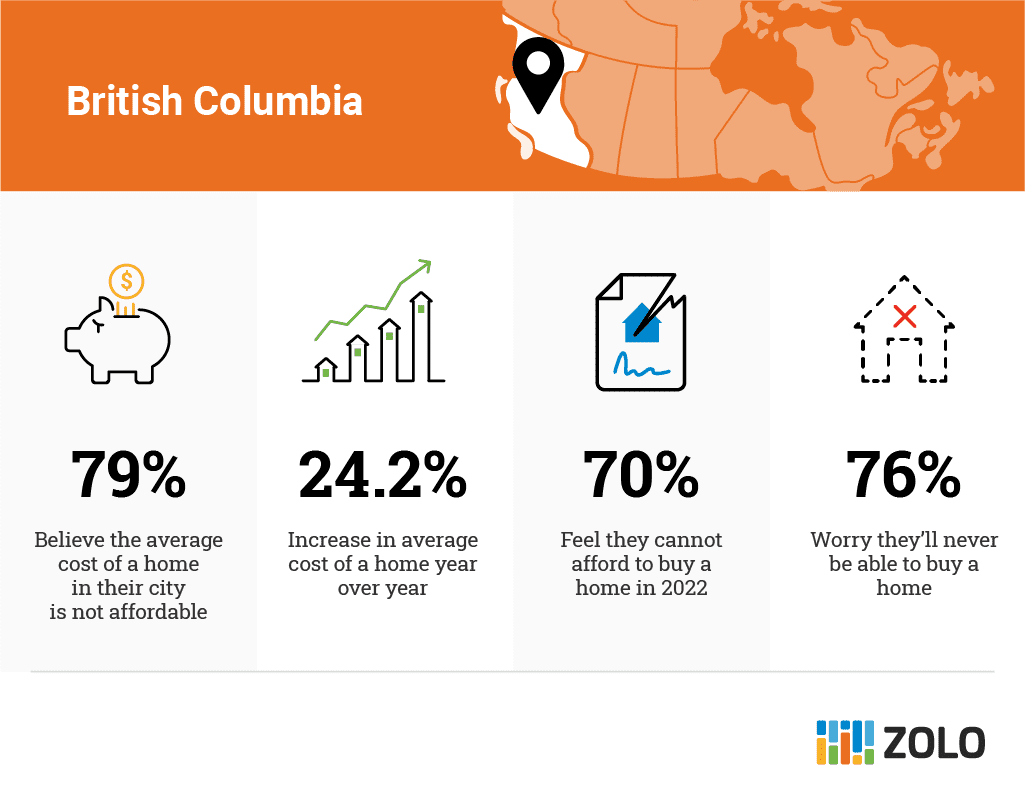
- 79% believe the average cost of a home in their city is not affordable
- 24.2% increase in average cost of a home year over year
- 70% feel they cannot afford to buy a home in 2022
- 76% worry they’ll never be able to buy a home
#3. Ontario

- 76% believe the average cost of a home in their city is not affordable
- 25.3% increase in average cost of a home year over year
- 66% feel they cannot afford to buy a home in 2022
- 74% worry they’ll never be able to buy a home
To see a complete breakdown of how each province feels, see data below.
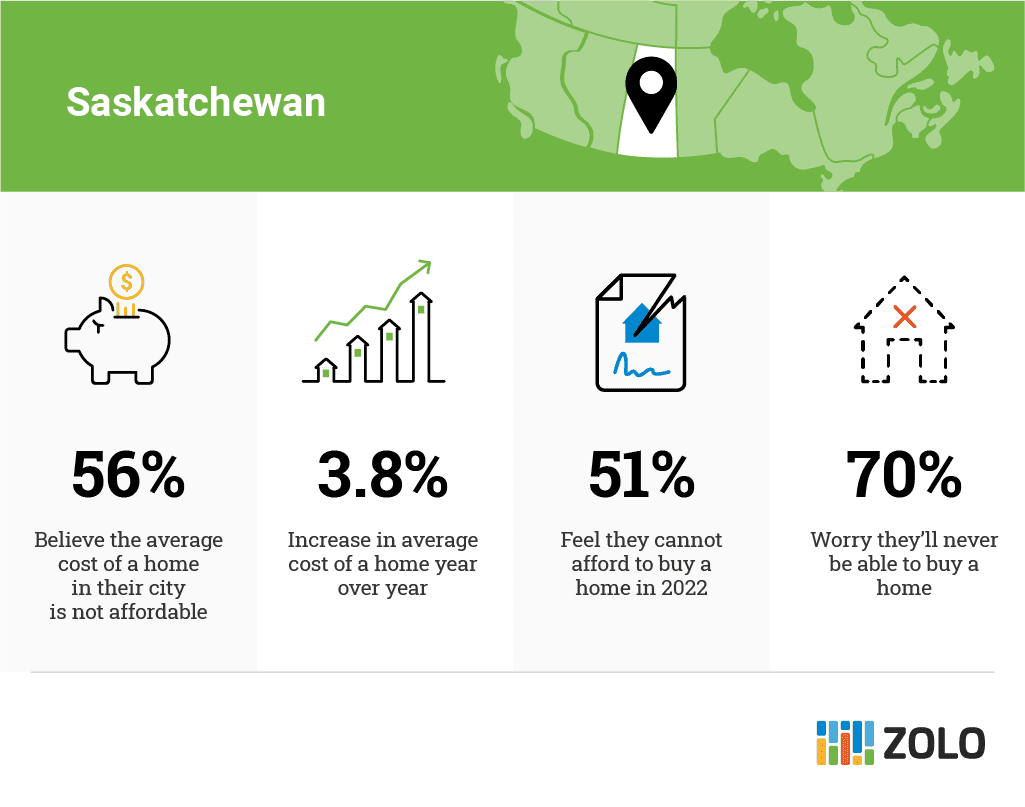
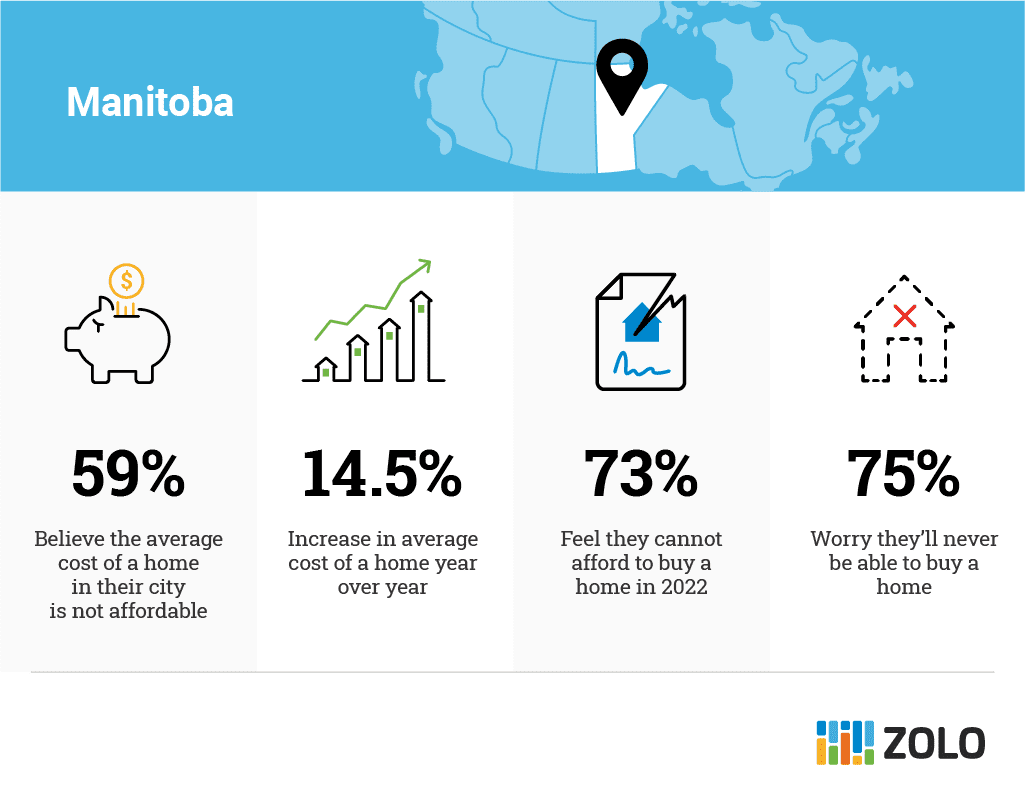
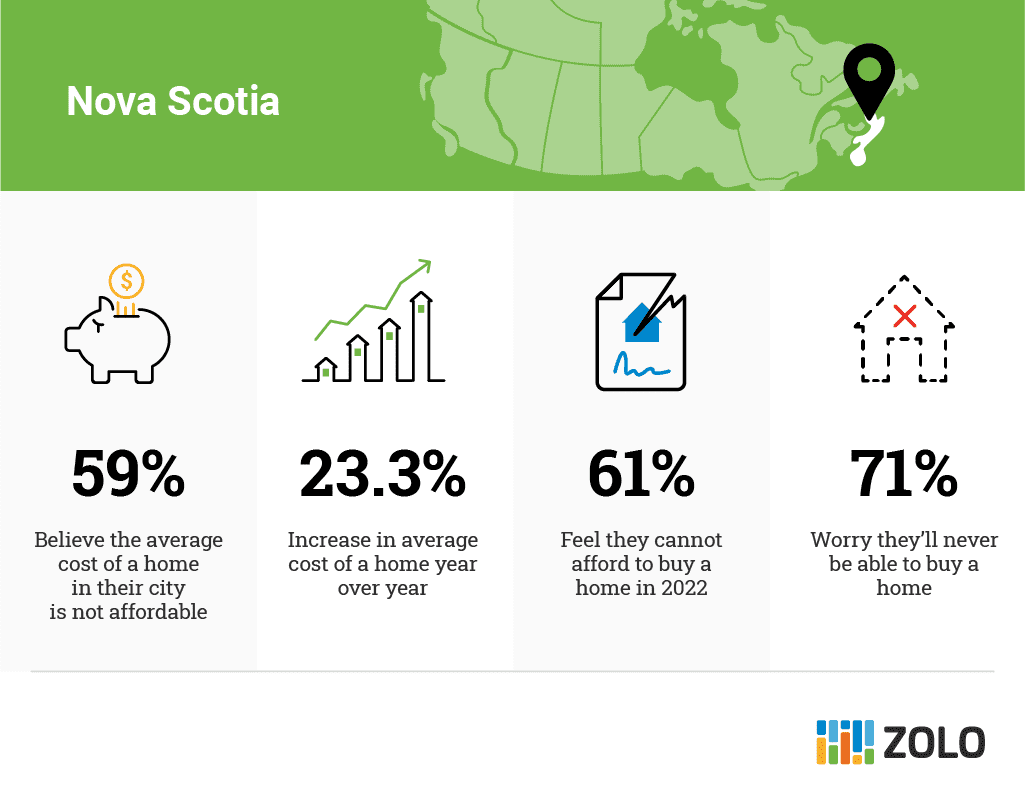
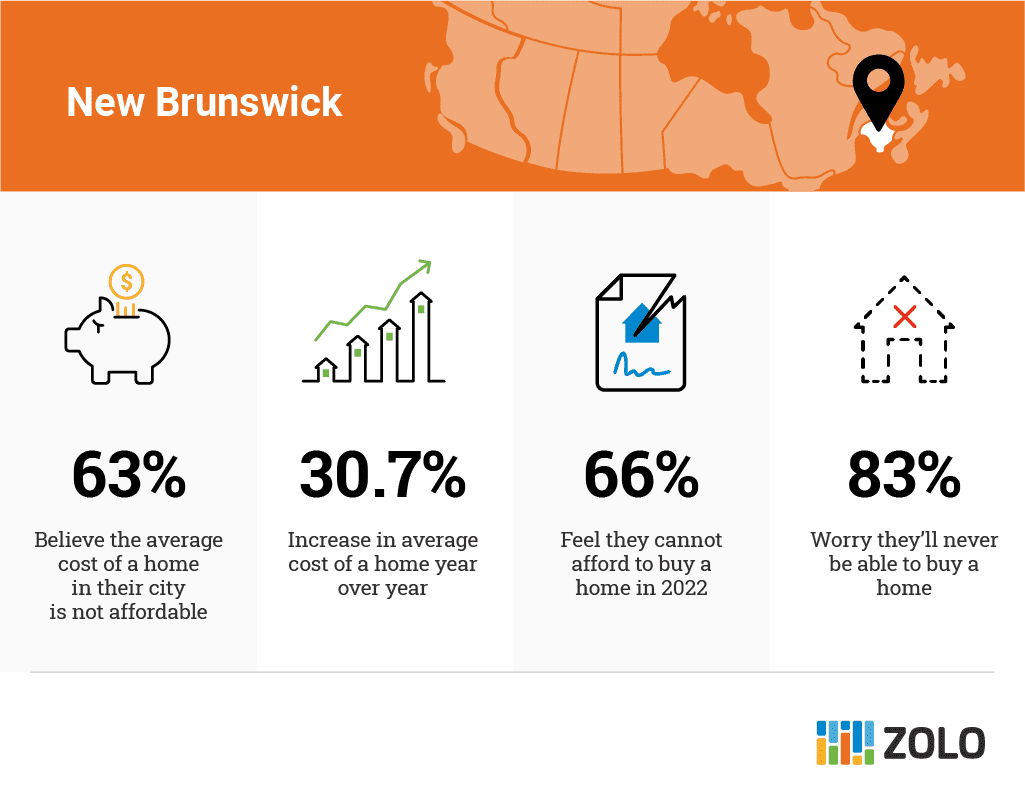

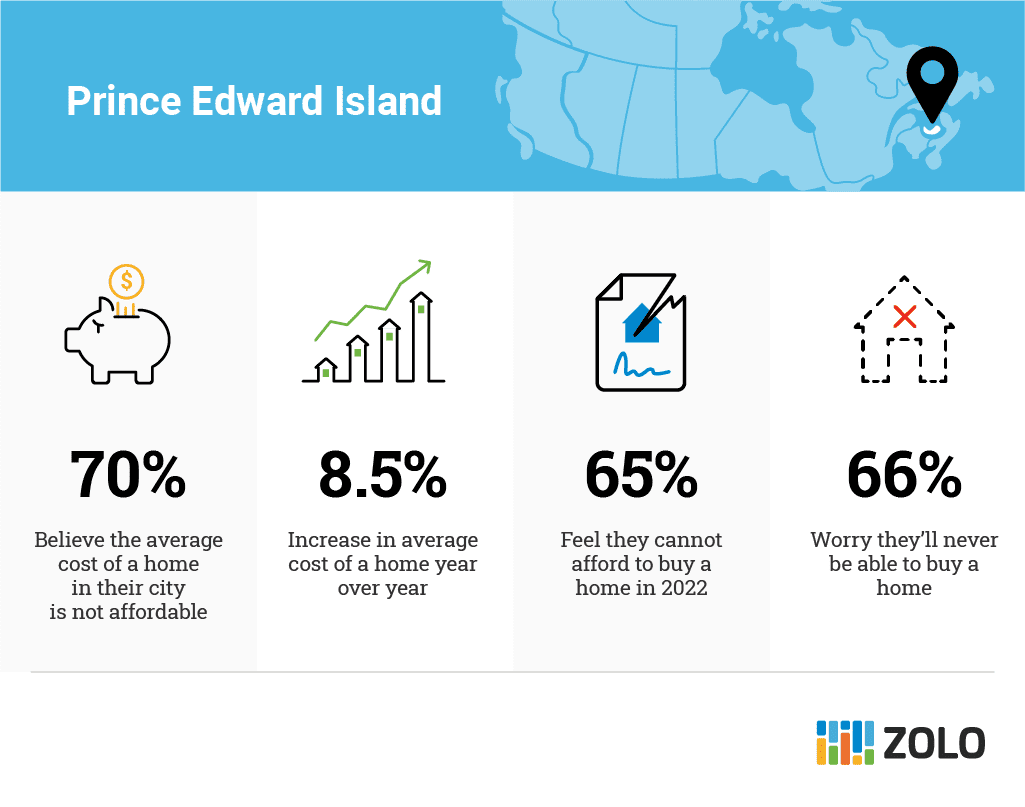
Of the Canadians Zolo surveyed, 30% believe the competitive market is the greatest challenge to buying a home. It makes sense, given the Canadian Real Estate Association (CREA) says that buyers faced a record listings shortage at the beginning of 2022.
Emma Dizon, 27, of Calgary, Alberta, says that finally landing her new place took time. After losing out on a 15-offer bidding process for one home in February, they finally bought another property — but not without outbidding three other potential buyers.
Initially, Dizon and her partner were looking for a detached home. But, after missing out on what she felt was the perfect home, they switched gears to hunt for a semi-detached house. “We were eventually priced out of the detached market,” says Dizon.
Staying Optimistic in a Difficult Market
These difficulties and obstacles leave 64% of Canadians feeling pessimistic about the 2022 housing market predictions in Canada. Although it can feel like there are no options or opportunities for first-time home buyers, 2022 housing market predictions aren’t the only area of consideration.

Given that buyers are most concerned about inflation, it’s essential to acknowledge other vital factors that could ease inflation and spur economic growth.
The Bank of Canada expects supply disruptions to dissipate gradually by 2023. The combined impact of free-flowing supply chains, reduced energy prices, and rising interest rates should help to rebalance our economy.
For that reason, if buying a home in 2022 isn’t an option, Canadians shouldn’t fear being locked out of the market entirely. Real estate operates in a cycle and will have moments of both highs and lows in the years to come.
“A balanced market tends to favour home buyers as there is more supply (choice) and less competition which means fewer multiple offers,” says Abbasi. “If you have been locked out of the market for the last 20 months, it might be a good time to start looking again.”
Survey Details
The survey data used for the Zolo North American Buyers’ Sentiment Report was collected through an online survey in April 2022.
The online survey asked 865 respondents a variety of opinion, self-report and knowledge-based questions to measure their opinion on the current real estate market, their plans to purchase a home, and their feelings about buying property. With current housing market predictions for 2022 in Canada, we wanted a real look at average buyers.
The estimated margin of error is +/- 3 percentage points.