The tiny house movement — also known as the tiny home or small-house movement — is both an architectural movement and a social-consciousness that is built upon the principles of simple, eco-friendly choices. In a world obsessed with personal space, tiny homes make it possible for home buyers to get into the housing market at a price-point that makes sense. The trick is learning how to live big in a tiny house.
What Qualifies as a Tiny Home?
Some debate exists as to what can be considered a tiny home and where these structures can be built. In some cities, there are zoning regulations that restrict anyone from building a home that is less than 800 square feet.
Yet as tiny houses start to become a popular and affordable solution, all of these limitations could change.
How Big Are Tiny Homes?
The average size of a North American house is about 2,400 square-feet. Tiny homes don’t even come close to that size. Most tiny houses are located in tiny house communities or they are built on wheels and range in size from 100 to 400 square-feet of liveable space.

According to the BC Tiny House Collective, there is no one definition of a tiny home. Still, most tiny home advocates generally consider a home to be ‘tiny’ if the total living space falls between 60 and 500 square feet. (There are builders and sustainable living advocates who argue that the range should extend up to 1,000 square feet, but you end up venturing into small house territory at this size.)
Another important feature is that the home must be a single separate identity — either a single detached or a semi-detached residence. This means that the home must be its own residence, not attached to any other dwelling; however, tiny homes can be built on wheels (or attached to a mobile axle).
If your aim is to build or buy a tiny home that is transportable, then keep in mind that highways and roadways also have size limitations. For instance, if you want to move your tiny home along North American highways and without the need for a special permit, then your tiny home on wheels cannot be any larger than 13.5-feet tall, 8.5-feet wide, and 40-feet long. Also, the tiny home and the vehicle used to tow your home cannot be any larger than 65-feet long.
To help, here’s a quick cheat sheet on how long your trailer must be to move your tiny home (assuming you are using a standard trailer with a width of 8 feet):
| Trailer Length | Max Square Feet of Tiny Home |
| 8 feet | 64 SF |
| 12 feet | 96 SF |
| 20 feet | 160 SF |
| 24 feet | 192 SF |
| 30 feet | 240 SF |
If you opt to use a gooseneck trailer, you can start to move larger tiny homes:
| Trailer Length | Max Square Feet of Tiny Home |
| 34 feet | 272 SF |
| 35 feet | 288 SF |
| 43 feet | 344 SF |
What Are the Benefits of Tiny Homes

For interested homeowners who plan to minimize their environmental impact, avoid being shackled to a mortgage, or embrace a minimalist lifestyle, a tiny home is increasingly becoming a popular choice.
Here are some of the main benefits of living in a tiny house today.
Tiny Homes Cost Less
Compared to building a full-sized house, a tiny home costs significantly less. According to experts, one can build their own tiny house for an average of around $23,000. In contrast, full-sized homes cost about $272,000, approximately 10 times as much.
By cutting down on housing costs, tiny house owners can instead put the money towards other important things.
Tiny Homes Are Easier (And Cost Less) To Maintain
Having a tiny house is easier to take care of compared to a standard-sized home. Since there is less space to clean and there are fewer appliances to manage, tiny homeowners can spend less time handling chores.
They can instead allocate more of their free time for their hobbies, work, and relationships.
Tiny Homes Are More Sustainable (Better for the Environment)
Another benefit of tiny houses is that they are easier to maintain in terms of bills. The bills for fuel, electricity, waste disposal, and water are all much lower when you live in a tiny home.
Aside from that, it is far easier to live off the grid with a tiny house since you can cool or heat the whole space using just a small solar array.
Many tiny homes even feature composting toilets that help break down waste without the need to be connected to a sewage system.
Tiny Homes Can Promote a Healthier Mindset
Everyone needs to de-clutter their life at some point. For those who lived in a traditional home for many years, things can easily pile up everywhere.
With a 200-square-foot home, it is simply not possible to store everything here, so you will have to sell or donate many of your things.
Doing so gives you the chance to really analyse your possessions and see which ones matter the most.
How Much Do Tiny Homes Cost?
Now that you know tiny houses are typically less costly than traditional homes, how much money do you need to spend for such small dwellings?
Here are some things to consider when buying, building, or renovating a tiny home.
For people who are looking for a roaming home — a tiny home on wheels — that has all of the necessities for full-time living, the average cost for such a tiny house is around $60,000. These tiny homes come equipped with the basic amenities, such as a bathroom, kitchen, sleeping areas and common living space, and they are also moveable.
How to Buy Tiny Homes?
The up-front cost of a tiny house depends on the size, finishes, and amenities; the final cost will also depend on whether or not you build it yourself, buy a pre-fab or a pre-owned tiny home, a builder’s model or choose a custom-build. As a result, the final price of your tiny home purchase can be anywhere from a $1,000 to $150,000 or more.
One of the easiest ways to buy a tiny home is through a tiny house builder and one of the more popular tiny home builders in North America is Tumbleweed Tiny House Company, founded by Jay Shafer in 1999 and based in Colorado Springs.
Like most tiny house builders, Tumbleweed sells a few models of tiny homes: the Elm, the Cypress, the Farallon, and the Roanoke. Each are designed to sit on trailer beds and function like RVs. Each base model comes in a variety of sizes and floor plans with price and size ranging from $69,000 for a 164-square-foot Cypress model or $57,000 for the 174-square-foot Roanoke model to $78,000 for a 204-square-foot Elm, and $77,000 for the 225-square-foot Farallon. Certain finishes and features will add to the cost, as will the distance it takes to ship the tiny home to you (the closer you are to the builder’s site, the cheaper the shipping). Then there’s the cost of the trailer that will act as your tiny home’s foundation. Most trailers cost between $3,000 and $10,000, plus license and registration.
Another option is to check the online marketplace sites for builders or private sellers listing tiny homes for sale.
Finally, you could choose to build your own tiny home either by purchasing tiny home build designs from a builder, like Tumbleweed, or through your own designs and creativity.
If you are considering a purchase of a tiny house — either a new build or a resale — keep in mind that it can be difficult to find a standard mortgage for a tiny home purchase. To purchase a tiny home, then, you must have either cash in hand or seek alternative financing.
Depending on the case, you could use a line of credit, a recreational vehicle loan, or a personal loan to purchase a tiny home.
Where Are Tiny Homes Legal?
Tiny homes may be growing in popularity but the legality of where they can park and live is still a little uncertain. In fact, finding out where it’s legal to build or park a tiny home is still a bit fuzzy with many municipalities undecided on how to classify a tiny house: Is it a mobile home, a recreational property (on wheels) or a single-family residence?
In general, however, the zoning rules in most major cities and towns in Canada prohibit tiny houses from being built or parked. Although, some municipalities are actively examining how to include tiny houses through amendments to current zoning laws.
Why Zoning Rules?
Zoning — or local building codes — help establish the minimum safety and construction standards for both residential and commercial structures. These rules also helps determine which types of construction projects need a building permit and help protect the character of a neighbourhood by restricting (or allowing) what types of structures can be built (and how these structures are used).
To prevent disappointment — and extra costs associated with having to move a tiny home — it’s wise to investigate the legalities for tiny homes in the municipality you want to live. Talk to the city planning department as well as the bylaw and building codes officials. Be sure that whatever your plans, they are within the city’s legal requirements.
In general, however, there are a few guiding principles when it comes to determining whether or not tiny homes are legal:
- Moveable tiny homes (those built on wheels) are typically limited to where you are allowed to park. That’s because most municipalities view these tiny homes as akin to recreational vehicles.
- Some RV parks will also allow you to park and live in a tiny home on wheels, but not all. A BC couple were surprised to be turned away in 2017, when their mobile tiny home didn’t meet the RV park standards.
- Many zoning laws have restrictions on the size of homes; turns out, it’s illegal to build a home smaller than a stated square footage in many cities in Canada.
- Keep in mind that most tiny homes must comply with Canadian Standards Association (CSA) regulations. The CSA standards that apply to tiny homes include:
- CSA Z240 MH Series
- CSA Z240 RV Series
- CSA Z241 Park Model Trailer
- And the ability to pass the deformation-resistance text provided in CSA Z240.2.1
- To park and live in a campground with your tiny home you will probably need to show that your home is built according to park model RV regulations and has the RVIA seal.
Are Tiny Homes Legal in Alberta?
In Alberta, the tiny home movement is thriving. In December 2019, the Edmonton City Council approved an amendment to the zoning bylaws that would allow for the off-site construction of a tiny home that would then be installed as a garden suite on an existing property lot, or as a single-family home on an existing property lot. The amended bylaws meant that the size requirements of new builds — which originally required all new builds to be at least 5.5 metres wide — were removed (allowing for the legal construction and use of tiny homes) and the new zoning now has performance standards that apply to the undercarriage of mobile tiny homes.
Unfortunately, not all cities in Alberta are quite as excited about tiny homes. In the same year, more than 3,000 Calgary residents signed a petition to protest the proposed building of 42 affordable-housing tiny home rental units in Okotoks, a fast-growing exurb south of Calgary (a commuter community not located in the Calgary city limits, but close enough to be considered a bedroom community).
Are Tiny Homes Legal in BC?
The British Columbia Building Code does not prohibit tiny homes. In fact, the BC Building Code states that a home can be as small as possible provided it meets the Code objectives of safety, health, accessibility, fire and structural protection, and energy and water efficiency.
Keep in mind, however, that BC prohibits year-round living in RVs outside designated parks. Plus, no provincial or national building codes cover mobile tiny homes; the difficulty is that unlike mobile homes, which are constructed based on one-level living, mobile tiny homes present unique safety challenges because of the use of lofts, ladders, small stairs and other features characteristic.
Despite these progressive regulations, it’s still not possible to live in a tiny house in the City of Vancouver. In fact, the City of Vancouver currently does not allow tiny houses in any capacity — that includes tiny homes used as secondary suites or entry-level laneway homes or tiny homes parked or built in an RV park.
According to the City of Vancouver, tiny houses do not comply with city bylaws and building codes. To try and change this situation, the BC Tiny House Collective actively engages in dialogue with city planners in the hopes that new zoning laws can be created to help establish tiny houses as a homeowner alternative in Vancouver. The BCTHC is in talks with the city on these issues.
In other parts of the province, tiny homes are starting to take root. In Squamish, for instance, amendments to the 2016 zoning regulations meant there were no longer size requirements for laneway homes — opening up the possibility of tiny homes. However, the District of Squamish still does not allow for mobile tiny homes.
Like Squamish, Greater Victoria allows tiny homes as ‘garden suites’ but not as mobile homes alternatives. What’s worse is that most (if not all) RV parks on Vancouver Island do not allow mobile tiny homes on their sites, even if the small-sized accommodation complies with RV certification.
There is good news. Many municipalities and communities near Greater Victoria have now become open to the idea of tiny homes as a housing alternative. In an article published in 2019, five of the 13 communities expressed support for the use of tiny homes as garden suites or small houses located in the rear of existing housing lots.
Are Tiny Homes Legal in Nova Scotia?
In Nova Scotia, it’s technically illegal for the most part to live in the tiny homes on wheels because as moveable structures, they don’t fall under the building code. Instead, they’re classified as RVs.
One exception is Yarmouth, which includes tiny homes as a housing option within its municipal boundaries.
Are Tiny Homes Legal in Ontario?
Prior to 2019, it wasn’t legal to build a tiny home — or any housing structure — that was less than 800 square-feet in Ontario. Any housing must be built to the minimum square footage and adhere to all building codes and current bylaws. By late 2019, however, the Minister of Municipal Affairs and Housing, released new guidelines regarding the construction and use of tiny homes in this province. In general, Ontario guidelines would like to see the ability to construct up to three suites per property (but there is no rule saying municipalities must allow this densification or need to approve tiny homes to meet this density guideline).
Alongside the provinces’ expanding allowances on small-sized living, municipalities are also jumping on the tiny house bandwagon. Kitchener now allows tiny homes although, like many other Ontario municipalities, these homes must be no smaller than 188 square-feet. (Some cities still require that dwellings be at least 400 square-feet).
In Toronto, you can build a very small house, as long as it’s grid-connected and you apply for a building permit. Quite often, these tiny house building permits are approved for secondary units on a primary property (a laneway house, for example). At this point, city planners now have a clear mandate to consider rear yard garden suites as potential opportunities for the building of tiny homes.
Are Tiny Homes Legal in PEI?
Tiny homes are currently not permitted in many municipalities across PEI.
Are Tiny Homes Legal in Quebec?
The Quebec provincial regulation on the construction and transformation of buildings prohibits the construction of buildings less than 320 square-feet for a single-family home with one bedroom.
In Quebec, it’s prohibited to install a tiny home as a residential annex.
How to Build Tiny Homes?
It costs a do-it-yourself builder approximately $12,000 to $35,000 to build a tiny home, with the average cost sitting close to $23,000.
Compare this to the cost to build a standard single-family home, which comes in at around $275,000.
A good way to trim costs when building a tiny home is to use reclaimed materials. Another good option is to attend a tiny house–building workshop. Many first-time tiny home builders mentioned that a DIY class can help avoid the common blunders when constructing tiny homes.
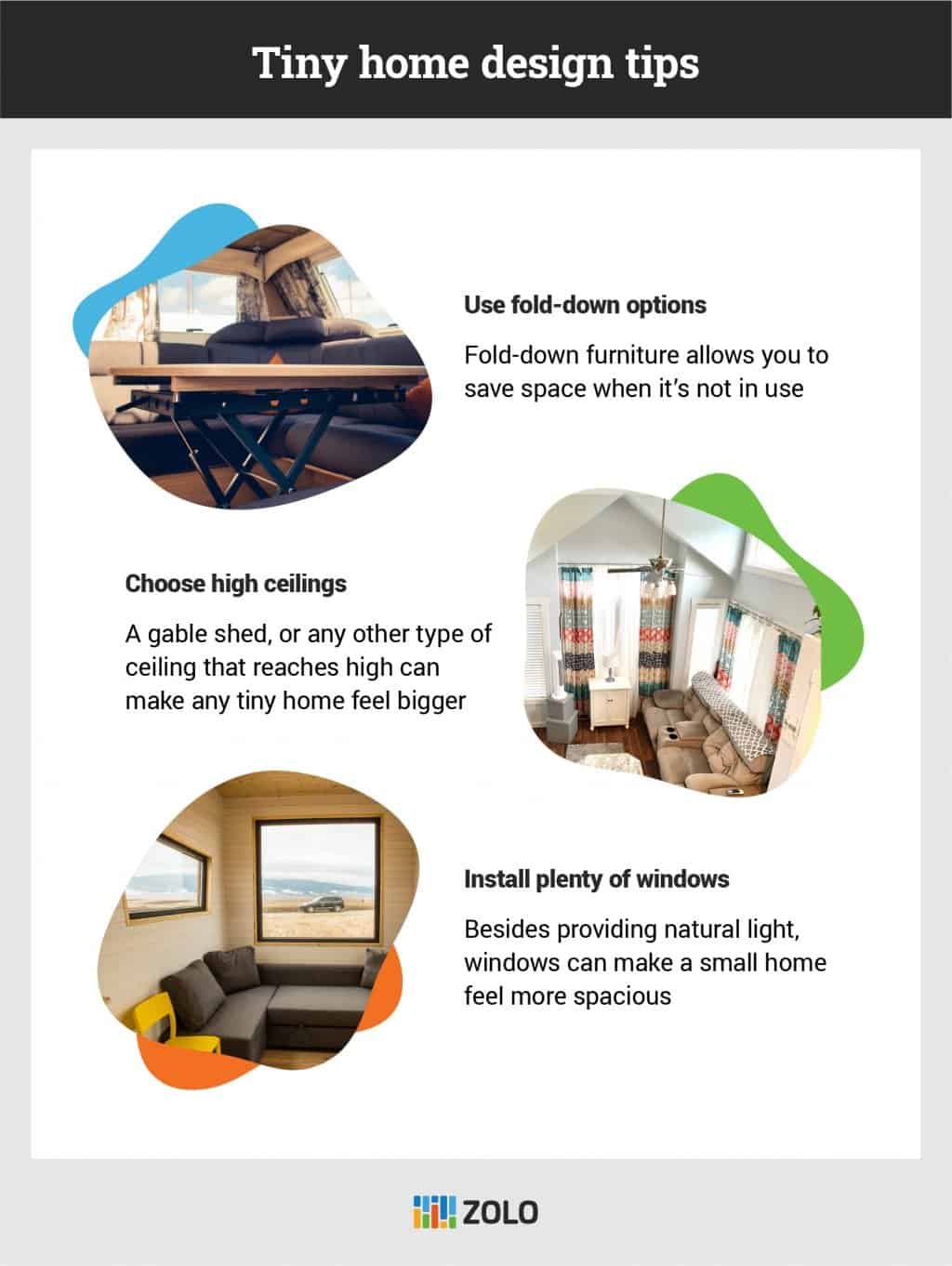
3 Tiny House Design Tips
When building a tiny house, here are some design tips to consider.
- Use fold-down options. Fold-down furniture is popular for tiny homes because of their ability to save on space when not in use. Being able to fold furniture into a wall, for example, can be a great space-saving solution.
- Choose high ceilings. Pick a tiny home build design that provides extra height. A gable shed, or any other type of ceiling that reaches high can make any tiny home feel bigger.
- Install plenty of windows. Besides providing natural light, windows can make any home feel more spacious. It is also a great way of letting you enjoy nature in the comfort of your tiny house.
How to Get Insurance on a Tiny Home
When it comes to insurance, providers often like lots of examples and lots of evidence — which is difficult to come by when it comes to tiny home living. Despite more than 10,000 tiny homes now built and in use in North America, for insurance company actuaries — the professionals responsible for analyzing statistics and assessing risks — this is still just too few to develop statistically reliable estimates. For that reason, getting insurance on a tiny home, with or without wheels, can sometimes be challenging.
Still, there are ways to increase your chances of obtaining home insurance for your tiny house.
Insurance for Tiny Homes Without Wheels
If you have a tiny house that is not built on wheels, then you will need to find an insurance provider that specializes in small or unique homes. A good option is to find an insurance broker — an independent insurance professional who works with many insurance providers.
If you purchased or built a tiny home on wheels and you are having trouble finding insurance coverage (or you’ve found a more permanent spot to park your home), then you may want to consider removing the wheels. This can become a hassle if you purchased the home for the portability, but it does eliminate a barrier to insurability. If you do remove the wheels, the insurance provider may require that you skirt the home — a process of blocking off the undercarriage and adding a foundation that will help to add insulation to your tiny home and keep the utility hookups from freezing.
Insurance for Tiny Homes on Wheels
For those who built their tiny homes on wheels, quite often these homes can be insured as a trailer or recreational vehicle. To get this type of insurance, you will need to supply a VIN and register your home with the Department of Motor Vehicles as a trailer.
Keep in mind, though, that to qualify for RV insurance the tiny home needs to meet the standards of the Recreational Vehicle Industry Association. Some insurance providers will not offer coverage if your tiny house isn’t built by a certified RV manufacturer.
Even if your tiny home was built by an RV manufacturer, any alteration can actually void your coverage. Insurance companies regularly deny claims if their adjuster discovers that a tiny home doesn’t meet all the specific requirements for coverage. For example, RV coverage requires the permanent installation of specific types of appliances and facilities in an RV (or tiny home) and the inclusion of these approved appliances allows the vehicle to obtain the RVIA seal. If you modify your tiny home, say by updating the appliances, then any insurance claims could be dismissed.
If you plan on moving your home only a few times or not at all, then a mobile home insurance policy may be a better option. This typically does not require you to register your home as a vehicle which may help you avoid additional licensing costs.
Another option is to find out if your current home insurance provider — assuming you already have a home with insurance — can offer coverage for your tiny home on wheels as part of personal property insurance. This coverage would not include towing your vehicle, so you wouldn’t be able to transport it and you may not be allowed to live in it full-time. Talk to your provider to be clear on the restrictions.
It is best to work with an insurance carrier that specializes in coverage for alternative living structures in all shapes and sizes says, Grenz.
The good news is that more insurance companies are moving towards the development of insurance plans that specifically address the kinds of situations that can happen with tiny homes both on and not on wheels.
What to Know About Living in a Tiny House
Are you ready to start living in a tiny house already? Here are some things to consider before deciding to purchase a tiny home.
Take the Tiny Home Lifestyle for a Test Run, First
No one wants to spend time and money on a custom-made tiny home only to learn that it isn’t right for them. To avoid any remorse after purchasing, you should allocate a week or so to living in a tiny home to see if you can handle it.
Tiny homes to rent
Experts recommend renting vacation cabins that portray living in a small space. Camping is also another way to help you determine what you really need.
Slowly Begin Downsizing
Once you start living in a tiny home, you won’t have the space to store all of your things. That is why it is best to start getting rid of them now by downsizing your stockpile.
Tips to help with downsizing
- Look for ways you can use space creatively
- Maximize your closet space
- Be picky about what you allow to come into your house
- Utilise vertical space
- Declutter often
Consider Your Power and Hook-up Needs
Most tiny homeowners decide to go the green route with their energy options, especially since a tiny home lends itself well to such ideas. It is best to assess the cost of installing solar arrays so you can understand how the system works and know what to do when needed.
Verify Local Zoning Laws: Where Are Tiny Homes Legal?
Although some places have adjusted their local zoning laws to allow people to live in tiny abodes permanently, most have not. Such structures are generally considered as RVs, which are considered as temporary housing units.
Before investing money into a future tiny home, check the zoning regulations of an area if you plan to live there permanently.
4 Tips for Optimal Tiny Home Living
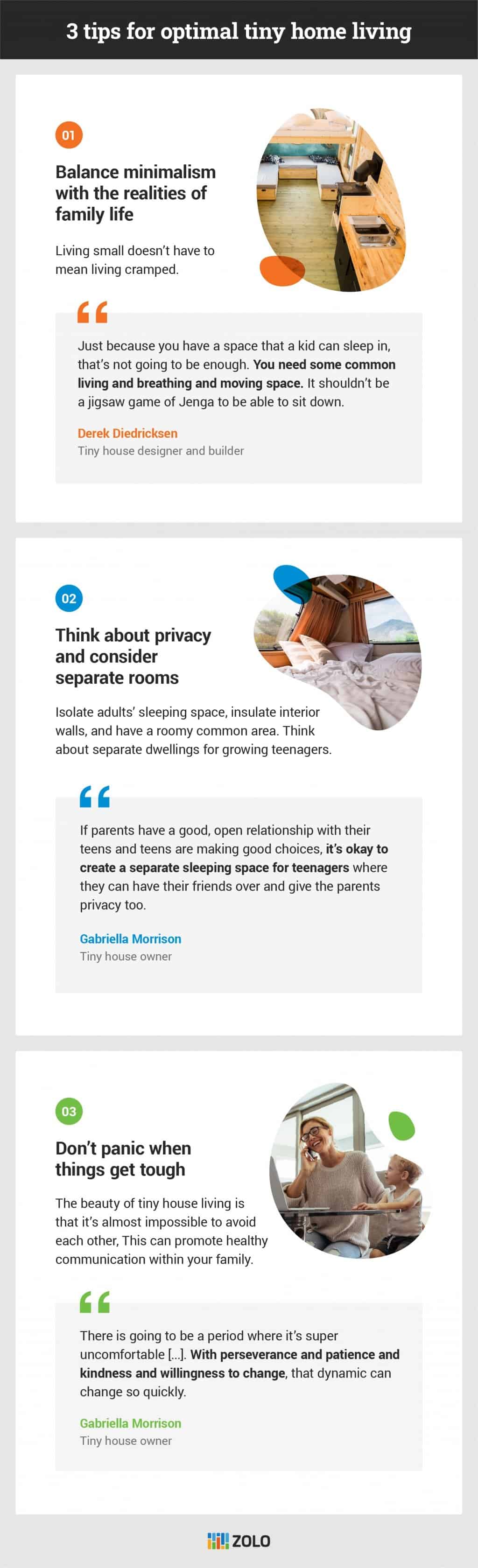
There are four key factors to consider if you want to make your tiny home work for you and your family.
- Balance minimalism with the realities of family life
“Just because you have a space that a kid can sleep in, that’s not going to be enough. You need some common living and breathing and moving space. It shouldn’t be a jigsaw game of Jenga to be able to sit down.” – Derek Diedricksen, tiny house designer and builder. - Think about privacy
Diedricksen suggests isolating adults’ sleeping space and insulating interior walls, as well as having a roomy common area. As kids grow, think about adding separate dwellings for teenagers. “If parents have a good, open relationship with their teens and teens are making good choices, it’s okay to create a separate sleeping space for teenagers where they can have their friends over and give the parents privacy too.” – Gabriella Morrison, tiny house owner. - Add windows and storage
Windows make a small space feel less claustrophobic, and storage is still a necessity, even if you’re planning to do with less stuff. Storage sheds can double as offices or even playrooms in a pinch, says Diedricksen. - Don’t panic when things get tough
“There is going to be a period where it’s super uncomfortable,” says Morrison. “With perseverance and patience and kindness and willingness to change, that dynamic can change so quickly.” The beauty of tiny house living is that it’s almost impossible to avoid each other, and that will prompt a family to really listen to each other and communicate issues effectively. You can’t just escape to your bedroom that’s hundreds of feet away.
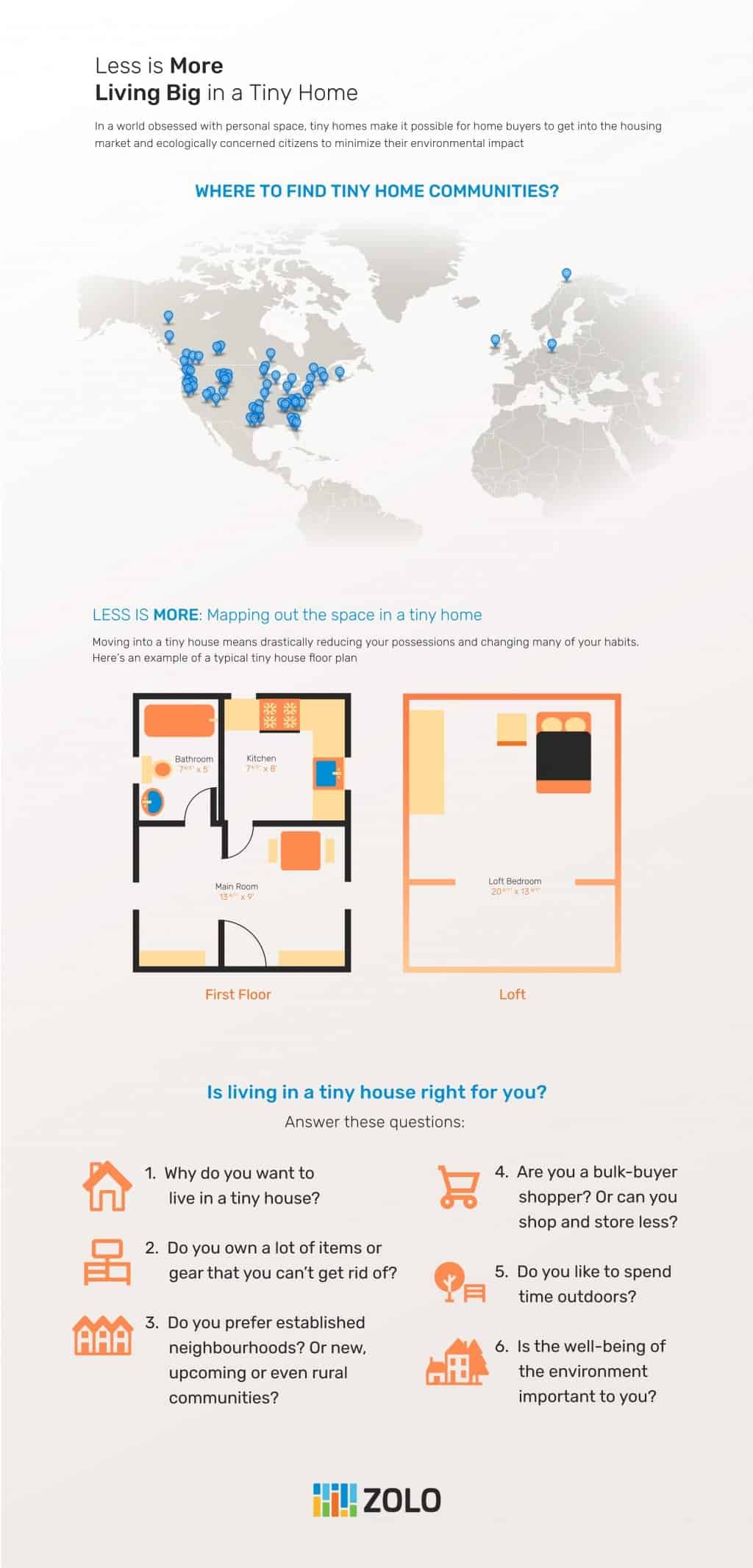
Where to Find Tiny Homes
As a movement, tiny home communities around the world promote financial discretion, economic common sense, a shift away from bigger and better and a deepening of community-spirit, earth-consciousness and human experiences.
There are a few communities in North America that have really embraced tiny house living. To instance:
- Bluegrass Meadow Micro Village opened up in 2015 as one of the very first tiny living communities in Canada. This small community is working to make it easier for people to find tiny homes in BC.
- The village of Calgary has made an amazing village of fifteen tiny houses built for the former members of the Canadian Armed Forces.
To find more tiny house communities check out Zolo’s tiny house searchable world map.
History of Tiny Homes
The tiny house movement started in the late 1970s, when American artist Allan Wexter and Shelter author Lloyd Khan, started to write and explore small space living.
While there were additional authors and advocates of this movement throughout the years, it wasn’t until 2003, when Jay Shafer started Tumbleweed Tiny House Company, a tiny house home builder, that the movement took off. Shafer’s role in the small house movement was predicated, in part, by his passion for this simple way of life. This passion led to the creation of the Small House Society in 2002, with tech-expert and social activist Gregory Paul Johnson (who is the co-founder and director for Resources for Life, an online community and free resource site for activists around the world.
When the Great Recession hit the global economy in 2007 (and lasting until 2009), the small house movement began to attract a lot of attention. It was an affordable, environmentally friendly approach to home ownership — an approach that went completely against the North American attitude of bigger is better. Between 1950 to 2011 the average house size went from 983 square feet to 2,480 square feet, according to Park Rag. This growth meant that in 60 or so years, each person in the household ended up with three times more space — going from 292-square-feet per person to 954-square-feet per person.
By 2012, Shafer had popularized the concept of the tiny house on wheels, after building and living in a 96-square-foot custom model. It was this home that prompted Shafer to begin planning and selling tiny house plans commercially and prompted him to start his initial company, Tumbleweed Tiny House Company. A little later he would go on to co-found Four Lights Tiny House Company. Finally, in 2014, the tiny home fascination hit the mainstream when two serial TV shows, Tiny House Nation and Tiny House Hunters hit the screens of homeowners and renters everywhere.