
Choosing the best lighting for your home may seem straightforward, but there is, in fact, a science. Learning about lumens, kelvin colour, and mixing metals will help you make every room in your home shine and illuminate your other décor choices. Create a cozy and inviting home that will attract buyers in a heartbeat with these tips.
Brightness has as much of an impact on your home as the paint colour or flooring choice. We’ve seen time and again homes that are in excellent condition, freshly painted, and well-styled. Still, they sit on the market for longer than necessary because the lighting in each room isn’t optimal, causing home buyers to shy away from making an offer.
Once you’ve learned a few fundamental rules, you can master the art of expertly illuminating any room, taking it from garishly bright or dingy and dark to the perfect balance of tone and brightness. Here’s what you need to know to light your home like an expert.
Essential Lighting Guidelines

Adequately lighting your home depends on your knowledge of how light works. Choosing the right lightbulb for any one space depends on a few key factors that we’ll delve deeper into below.
1. Temperature
First, consider the temperature of your lighting. The temperature of lighting refers to how blue or yellow a source is. You can measure the temperature of your lighting by assigning it a value on the kelvin colour scale. The kelvin colour scale measures the “warmth” of colours on a scale of 2,000 to 10,000 kelvins, with 10,000 being a very “cool” blueish tone and 2,000 being a very “warm” yellowish tone.
Most lightbulbs for home decor tend to be in the 3,000-kelvin range, but the colour you choose should depend on the room itself.
For example, let’s say you are lighting a room with no exterior windows to provide a cool light source – light from windows is always blueish. If you choose a standard 3,000-kelvin lightbulb, your lighting may end up looking very yellow, which can cause any red, orange or pink tones in the room to become very pronounced. To solve this problem, consider choosing a slightly cooler kelvin colour lightbulb. The higher Kelvin number will result in a somewhat cooler look for the room and balance any red tones without becoming too sterile.
The opposite may be valid for a room with an incredible amount of natural light, especially indirect light, which tends to be higher on the kelvin scale. In this case, adding warmer lighting will offset that cool natural light and make the room seem cozier.
Here are some common do’s and don’ts when it comes to choosing the temperature of your lighting:
Checklist for Choosing the Right Lighting Temperature
- Use kelvin colours to achieve a balance lighting temperature – not too cool, not too warm
- Use cooler kelvin colours for task lighting
- Use cooler kelvin colours for rooms without natural light
- Use warmer kelvin colours for rooms with lots of natural light
What to Avoid When Selecting the Right Lighting
- Mix different kelvin colour bulbs in the same room, choose one colour for the entire room
- Be afraid to experiment with different kelvin colour values
2. Brightness
Beyond the temperature of the lighting in a room, you should also consider the brightness of each lightbulb. While we once measured brightness in watts, a unit of power, this is no longer a reliable measurement. Now that LED lighting has become common in homes, the wattage of the average bulb has dropped significantly.
As a result, LEDs considerably lower your electricity consumption because they consume far fewer watts than the average incandescent bulb. However, you can still determine their brightness using a different measurement: lumens. Lumens measure the total quantity of light emitted by a source of light.
The average lightbulb emits about 800 lumens, roughly equivalent to a 60-watt incandescent bulb. While an 800-lumen lightbulb is appropriate for lamps and recessed lights, you can choose lightbulbs with more or fewer lumens for another lighting.
For example, if you have a room (say, a home office in a basement) that tends to seem very dark, you could choose a lightbulb with more than the standard 800 lumens. For example, these Philips 1500 lumen, 2700 kelvin LED lightbulbs from the Home Depot.
In contrast, if you choose lightbulbs for overhead pendant lights or a chandelier, multiple 800-lumen bulbs may be far too bright. In these cases, it’s sensible to select less bright lightbulbs, perhaps closer to 200 lumens.
3. Task, Ambient, or Accent
Finally, consider the purpose of the lighting when choosing brightness and kelvin colour. For example, if the illumination is the primary goal of the lighting, choose higher lumens and consider a cooler kelvin colour. On the other hand, if you want to add ambience, a warm white between 2,700 and 3,000 kelvins will reflect the true tone of your paint colour and flooring choices the best. Finally, for accent lighting, which is primarily meant to draw the eye to specific spaces around a room, lower lumens will prevent your accent lighting from overwhelming the space or drawing too much attention.
Finding the Right Light Fixtures
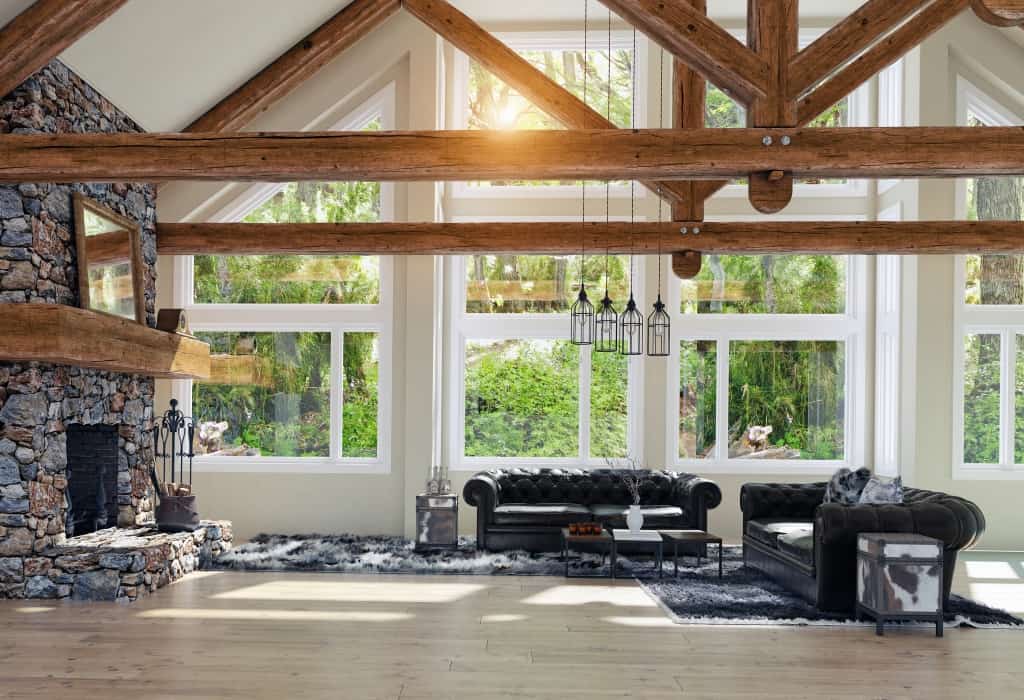
Now that we’ve armed you with choosing the proper lighting for your home let’s talk about fixtures — another integral part of lighting. Choosing the right fixtures is the final hurdle to a tailored system for your home, and here is our best advice.
First, you’ll want to layer at least two light sources in each room, and ideally three. This recommendation includes tiny spaces like offices or nurseries. Multiple sources will give you control over how well-lit you’d like the room to be at any time, allowing you to create a cozy atmosphere in the evening while still maintaining the level of illumination you need for cleaning or task work.
Second, when dreaming up ideas, you’ll need to consider the metals that make up the actual fixture. Ideally, you’ll select fixtures with a common theme throughout the house but don’t be afraid to mix metals. A popular way to mix metals is to choose a dominant metal (for example, aged brass) and another metal to accent it (for example, matte black). It’s best to avoid mixing more than two metals, and if there are other types of metal in the room (like cabinet handles, for example), try to coordinate as much as possible.
If you’ve settled on your ideas, make sure to double-check the size of the actual fixture, especially if you are ordering online. In particular, it may be challenging to visualize the size of chandeliers, overhead lighting, and pendants, so we highly recommend you take the measurements and physically measure the space to ensure the lighting you choose will be the correct proportions for the area.
Once you’ve got your fixtures, you’ll need to install them. Should you hire an electrician or do it yourself? On the DIY scale of difficulty, changing a fixture ranks at about two out of 10. It’s not difficult, but you’ll need a helper to hold the fixture while connecting the wires. To change a fixture, you’ll need a few tools:
- Gloves
- Wire stripper
- Noncontact voltage tester
While many informative YouTube videos show you a step-by-step process for replacing a fixture, here is a brief description:
- Shut off the breaker to either the fixture itself (and double-check the wires with your voltage tester) or (my preferred method) to the entire house.
- You’ll need to remove the old fixture and disengage that fixture’s wires with the house’s wiring. Then you’ll need to connect the wiring of the new fixture and attach it securely to the mounting base.
- Add the lightbulbs, turn on your breaker, and try out your new fixture.
Finally, no upgrade would be complete without also upgrading the light switchers. If you have almond-coloured toggle switches, you can make your home seem modern by switching to white paddle switches. The process of changing out a light switch is similar in complication to changing a light fixture, and you’ll need the same tools. If you want to elevate your lighting, even more, consider adding dimmers.
Home lighting is as essential as any other home décor feature like paint colours or flooring. It’s easy to pick the most straightforward and fastest options. Still, a little knowledge about lumens and kelvin colour will help you elevate your home’s lighting to a highly customized solution for every room.