If you enjoy gambling for big prizes, you have a lot of options in Canada. You could play the federal and provincial lotteries like the Lotto 6/49. Alternatively, if you’re looking for an experience, you could gamble at a racetrack or a casino. But if you’d prefer that your gambling do good, your best bet would be to buy home charity lottery tickets.
What is a Charity Lottery?

A charity lottery is any game of chance where a portion of the proceeds goes towards a charitable cause. Charity lotteries can be small, like a local 50/50 draw at a hockey arena in Abbotsford, BC. But charity lotteries can also be huge, with prizes like homes and cars. An excellent example of a mega charity lottery would be a home charity lottery. Home charity lotteries typically give away a house, condo, or cottage as the grand prize. They also have various smaller prizes including cars, vacations, merchandise, and cash. Home charity lotteries are a popular way for hospitals and other charitable organizations to raise money.
Charity lotteries are popular because lottery operators believe more Canadians will buy tickets if some of the proceeds go to charity. While this may be true, research shows mega-lotteries are not the most efficient way to donate money.
How Much do Home Charity Lotteries Benefit Their Causes?
If you’re considering buying home charity lottery tickets, you may wonder what percentage of your money goes to the charity. Fortunately, there are organizations in Canada dedicated to finding this information.
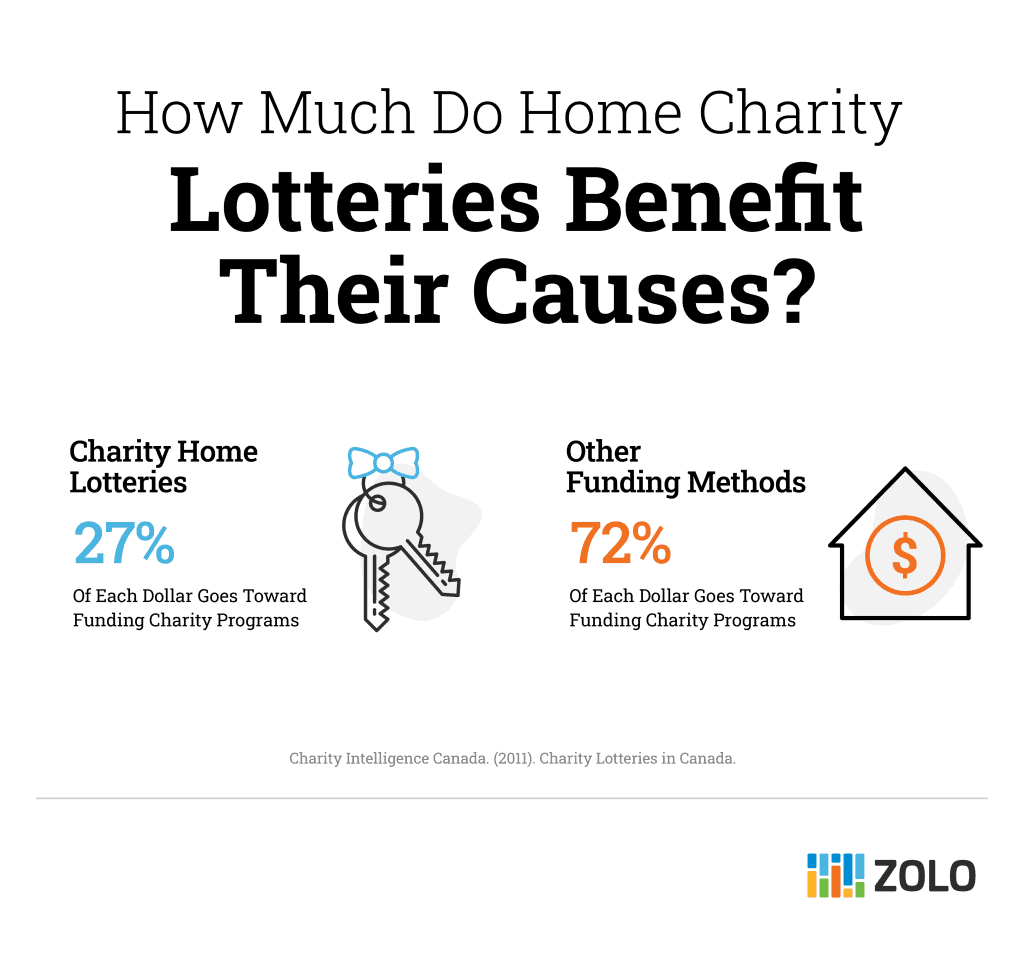
A survey of 30 home charity lotteries in Canada showed that, on average, 27% of each dollar goes toward funding charity programs. The survey was conducted by Kate Bah-en and her team of financial analysts at Charity Intelligence. This Toronto-based organization crunches data and financials to help donors determine where their dollars can have the most impact.
Bahen and her team found that the rest of the revenue pays for prizes and marketing and operational expenses. In contrast, the average amount of donations retained from other fundraising methods by the same charities was 72%. That’s a 45% difference between home charity lotteries and other types of fundraising.
But lottery operators aren’t competing for the donations of regular charitable givers. Instead, charity lottery operators use home charity lotteries to appeal to Canadians who otherwise might not donate at all.
Barbara Baarsma, the co-author of Better Chances for Charities, a report commissioned by the Dutch National Postcode Lottery, asserts that charities benefit from mega-lottery fundraising because it opens up a new, untapped revenue stream for organizations and causes. Plus, as Baarsma points out, “charity lotteries may also benefit in terms of increased brand awareness and knowledge [and] this can trigger lottery participants to give (more) direct donations to charity organizations.”
“Many lottery ticket purchasers view the charity lottery as a combination of philanthropy and gambling. To appeal to the gambler, some charities emphasize the limited number of tickets or the high odds of winning a prize, thus making the lottery odds seem favourable.”
– Kate Bahen, Charity Intelligence (Ci)
How Charity Lotteries Attract Ticket Buyers
These mega-lotteries need to get creative to capture some of Canadians’ estimated $750 million donations to charity lotteries each year. As a result, charity lotteries spend a significant portion of their operating budget getting the attention of Canadians who otherwise would not donate to any charitable cause. That’s why you’ll see full-colour, glossy advertisements in the mail and why you hear or see ads on radio or TV – because they are attention-getting.
There are two factors that charity lotteries use to attract Canadians and entice them to hand over their hard-earned cash:
- Prize magnitude – the size of the jackpot and secondary prizes
- Price-payout ratio – the odds of winning
Prize Magnitude
An enormous payout is guaranteed to attract ticket buyers, and a show home or cottage is attention-getting. The grand prize home’s value varies depending on the size of the lottery, but many home lotteries in Canada offer a grand prize home worth millions of dollars. Home lotteries often have dozens of other prizes, including cash, vacations, merchandise, and dedicated 50/50 draws.
Price-Payout Ratio
Another meaningful way that charity lottery operators attract ticket buyers is a high price-payout ratio. A price-payout ratio represents the odds of winning a prize. For instance, the Calgary Home Lottery, which benefits the Calgary Health Trust, advertise their odds of winning at 1 in 30. That means a prize is awarded for every 30 tickets sold.

Believe it or not, of these two factors, the biggest motivator is the probability of winning. According to a 2006 study published by Tilburg University, 40% of lottery ticket buyers will stop buying tickets due to a low chance of winning. As Baarsma and her colleagues state: “Participants expect to win a prize now and then.”
When you compare charity lottery odds to provincial or national lottery odds, you can see why. For example, you have roughly a one in 14 million chance to win Lotto 6/49 and a one in 28.6 million to win Canada’s national lottery, Lotto Max. Plus, if you play the national lotteries, you end up competing against more players. More players increase the odds of splitting the prize money between several winners.
That said, when comparing various lotteries, it’s not enough to simply look at the odds of winning. Some charities offer dozens of very small prizes which boost your overall odds of winning and may misrepresent your chances of winning a large prize. For instance, the OLG once offered a game with a 1 in 1 chance of winning, meaning every single ticket won. The catch? The base prize was $4, while the ticket cost $12.
Charity Home Lotteries Pay Out Less Than Other Lottos
While charity home lotteries spend considerable portions of their operating budgets on advertising big prizes and a high price payout ratio, it turns out that they pay out less, on average, than most popular government lotteries.
A home lottery payout is determined by calculating how much the buyer can expect back from the original ticket price. This analysis was done by Kate Bahen and her team of financial analysts at Charity Intelligence Canada. Bahen’s team found that provincial government lotteries provided the highest payouts (on average 54%). In contrast, the payout range for charity lotteries is as low as 27% or as high as 53%.
Ticket buyers need to consider whether or not you care about the size of the overall jackpot or whether you’d prefer to increase your odds at winning a prize (and, perhaps, helping out a good cause).
Which Lottery is Right for You?
Suppose you aren’t sure whether you should choose to buy mega-lottery tickets, charity home lottery tickets, or donate your money directly to a charity. In that case, your decision will come down to which experience you value the most.

If you want to maximize your odds of winning a huge payout and aren’t concerned about supporting a good cause, a mega-lottery like Lotto 6/49 is a good choice. Opting for a mega-lottery and buying several tickets will improve your chances of winning. In the US, where Powerball is the quintessential lottery to play, analysts constantly point out that if you were to buy one ticket, you’d have a one in 292,201,338 chance of winning the jackpot. Buy two tickets, and you’d have a two in 292,201,338 chance of winning, and so on.
If you want to have fun gambling while supporting a good cause, charity lotteries are the best of both worlds. Charity lotteries provide charities with a source of unrestricted funds, allowing the charities to fund their operations freely. In addition, they can help raise the charities’ profiles with their associated marketing.
Finally, if your primary concern is supporting a good cause, skip the lottery and donate to the charity directly. Directly contributing removes some of the fun of gambling. Still, it ensures that more of your dollars go toward supporting the charity and helping them perform their essential work. No portion of your donation goes toward advertising and administration of the lottery.
No matter what you choose, it’s critical to be smart about your lottery playing. Ric Wallace, a self-proclaimed “luckologist” and repeat lotto winner who spoke to MoneySense.ca, explains. “Our dreams are important, but play within your means, play as a group and always put it on paper.” For more play-safe tips, visit responsiblegambling.org.